The Lego Group is hosting its first-ever press conference at CES 2026 – but what the company is going to announce remains a mystery. While the huge toy brick creators haven't given any hints as to what they'll be showcasing, the possibilities run the gamut from new video games to Formula 1 race cars.
Here's how you can watch Lego's presentation at CES, and what we might expect to see.
How to watch The Lego Group's CES 2026 press conference
The Lego CES press conference is scheduled for Monday, January 5 at 1PM ET. While Lego and the Consumer Technology Association haven't yet provided the details, we expect that the press conference will be available as a livestream. Once the details are confirmed, we'll update this post to confirm them. But if a livestream isn't immediately available, the Engadget team will be liveblogging the Lego presser and posting timely details.
What to expect
Thus far, Lego hasn't shared any public info about its CES plans, so we're largely in the dark as to what to expect. At CES 2025, for instance, the toy production giant partnered with Sony to announce the animated Lego Horizon Adventures online game. As such, Lego may spend some time talking up its new 2026 game, Lego Batman: Legacy of the Dark Knight. The company may also give some stage time to its Lego Group F1 Academy racing car, though that too would be more about brand building than consumer products.
While there are plenty of new Lego sets for 2026, however, this is CES, not Toy Fair. So we're assuming that the company will be showcasing something that's more tech-centric. Stay tuned.
This article originally appeared on Engadget at https://ift.tt/Un3sKdu
from Engadget is a web magazine with obsessive daily coverage of everything new in gadgets and consumer electronics https://ift.tt/Un3sKdu
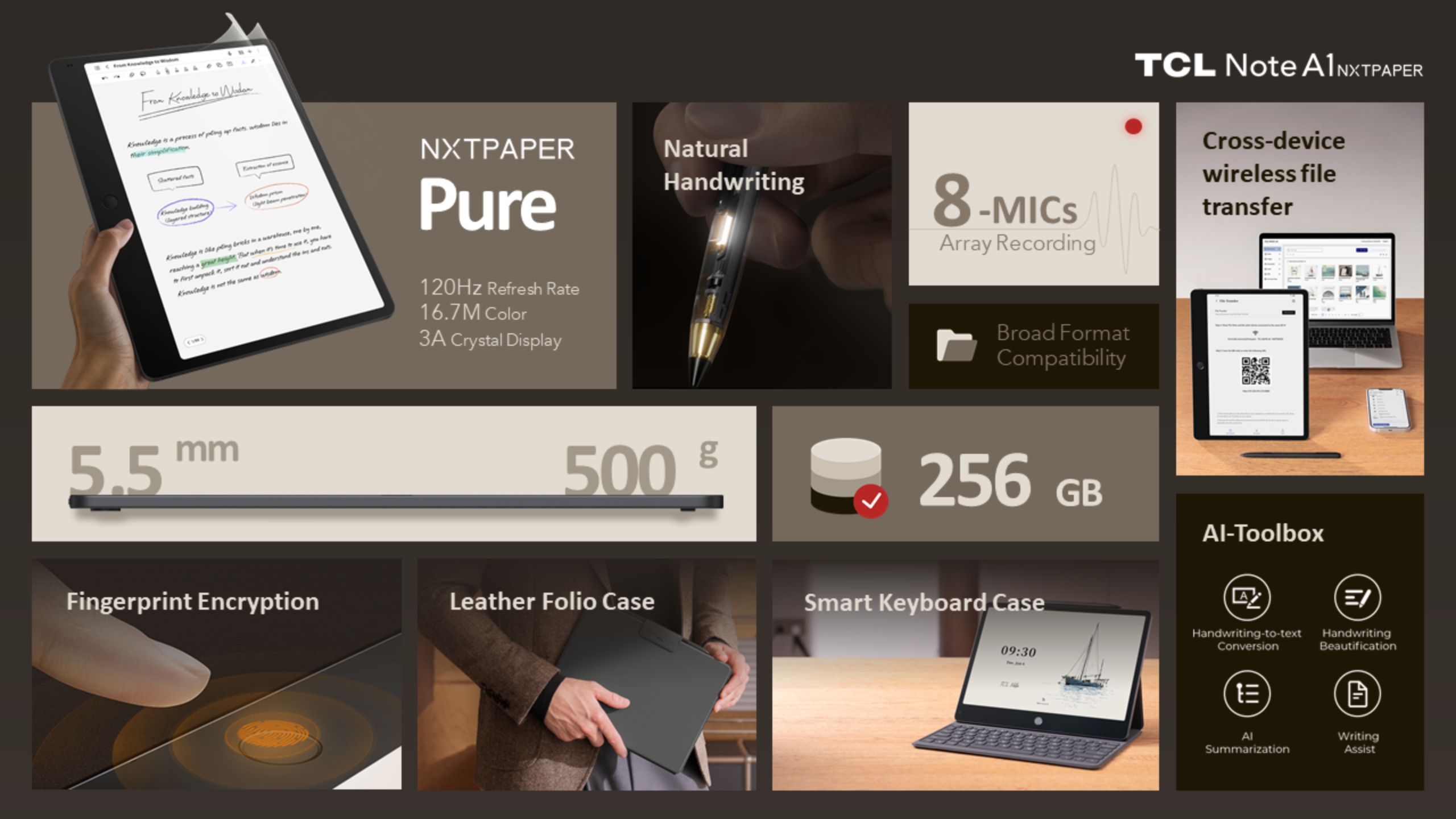
Hot on the tail of Amazon's Kindle Scribe Colorosoft, TCL is introducing its own take on a distraction-free note-taking and reading device. Unlike the new Scribe, however, it doesn't use E Ink. The TCL Note A1 NXTPAPER is the company's latest device to use NXTPAPER, TCL's custom paper-like LCD screen, which offers some of the qualities of E Ink without the limitations.
TCL says the 11.5-inch color "NXTPAPER Pure" display on the Note A1 has a 2,200 x 1,440 resolution and a 120Hz refresh rate, which should mean it looks clearer and feels much smoother to interact with than the color E Ink screen used on something like the reMarkable Paper Pro. The tablet supports TCL's T-Pen Pro for taking notes and drawing on the screen, but also features eight built-in microphones for recording and transcribing audio. The Note A1 also has a 13-megapixel camera for scanning documents, an 8,000mAh battery and 256GB of storage, with the option to access cloud services like Google Drive or Microsoft OneDrive if you want it.
A diagram of different Note A1 NXTPAPER features arranged in a grid.
TCL
Unlike TCL's past NXTPAPER tablets, the Note A1 doesn't prioritize media consumption — it's a productivity tool first and foremost. TCL says the device runs Android, but hasn't shared whether it'll have access to the Play Store. All the features the company has announced focus on taking notes and using AI to process and organize whatever you've written down. The device will also support real-time translation and "handwriting beautification," among a collection of other AI-powered features.
Engadget has reached out to TCL for more information on the Note A1 NXTPAPER's software. We'll update this article if we hear back.
There will likely never be one “Goldilocks” version of these note-taking devices, but the Note A1 NXTPAPER's combination of display and microphones does make it an intriguing, if limited, alternative to Boox's E Ink tablets. Anyone interested in TCL's new device won't have to wait long to try it, either.
The TCL Note A1 NXTPAPER is available to order now through Kickstarter (with additional bonuses and discounts) and will officially go on sale for $549 at the end of February.
This article originally appeared on Engadget at https://ift.tt/JECUbMQ
from Engadget is a web magazine with obsessive daily coverage of everything new in gadgets and consumer electronics https://ift.tt/JECUbMQ
CES 2026 is right around the corner, and the pre-show hype cycle/ early reveals suggest, yes, there’s going to be an awful lot of AI-powered insert-product-category-here alongside, thankfully, some major announcements from the likes of Intel, Sony and NVIDIA.
Intel is finally unveiling its Panther Lake (Core Ultra Series 3) chips. The first chips built on Intel’s 2nm process could offer a 50 percent performance boost, which is sorely needed amid intense competition. NVIDIA’s Jensen Huang is taking the stage for a keynote expected to feature a lot of AI hype, while AMD’s Lisa Su will likely counter with new Ryzen 9000-series chips and the latest on AI upscaling tech.
Over the years, CES has consistently been the show for TV innovation and heady next-gen displays. This year, we’ll be talking a lot about Micro RGB. LG is introducing a new Micro RGB Evo panel with over 1,000 dimming zones, while Samsung plans to launch a full range of Micro RGB TVs from 55 inches to 115 inches. In 2025, Sony introduced a new RGB LED panel that uses individual Mini LED backlights in red, green and blue to produce even brighter, more accurate colors. The company has trademarked “True RGB,” which could become what Sony calls its spin on RGB displays.
We’ll be covering all the keynotes, press conferences and big reveals in person. And figuring which of the 100s of AI-branded devices and gadgets are worth reporting on.
I’m also taking bets on the most niche celebrity appearance/endorsement at CES 2026. We’ve seen 50 Cent, Big Bird, Martha Stewart, Archbishop Desmond Tutu, Guillermo del Toro, Justin Bieber and will.i.am (multiple times), so who will join this pantheon of stars?
It isn’t just TVs with Samsung. The company has already teased a pair of new understated speakers. Likely inspired by the Samsung Frame, the new Wi-Fi speakers, called the Music Studio 5 and 7, blend into your living room. The Music Studio 5 has a four-inch woofer and dual tweeters, with a built-in waveguide to deliver better sound. The Music Studio 7 comes with a 3.1.1-channel spatial audio with top-, front-, left- and right-firing speakers. No prices yet. Expect to hear more at CES itself or once the speakers arrive in stores. And as the press image above suggests, we can't wait to sit stoically in front of one, with a glass of water (?).
Xiaomi’s latest smartphone is once again a spec beast. It features a 1-inch sensor 50MP f/1.67 main camera and 1/1.4-inch 200MP periscope telephoto camera. And it also has an interesting new mechanical feature: a manual zoom ring. This surrounds the rear camera unit.
Both the regular Xiaomi 17 Ultra and Leica edition come with a Snapdragon 8 Elite Gen 5 SoC with up to 16GB of LPDDR5X RAM and 1TB of UFS 4.1 storage, along with a 6.9-inch 120Hz AMOLED display that can hit up to 3,500 nits of peak brightness.
But the camera features are the standout elements. The 17 Ultra by Leica adds some very, well, Leica touches: a two-tone finish, red dot status symbol on the front, textured edges and film simulations, like Leica’s Monopan 50 black and white. Xiaomi says the zoom ring “[eliminates] the need for tedious screen taps... and can detect displacements as small as 0.03mm.” It can also be reprogrammed for manual focus.
Xiaomi’s 17 Ultra by Leica and the regular 17 Ultra start at CNY 7,999 ($1,140) and CNY 6,999 ($995), on par with the latest high-end Pixel 10s and Galaxy S25s.
A Google support page in Hindi says the feature is ‘gradually rolling out to all users.’
A Google support page in Hindi indicates the ability to change your Gmail address might be coming. The feature would allow you to replace your current @gmail.com address with another. Your old address would remain active as an alias on the account, and all your data would stick around, unaffected. The support page (translated) says “the ability to change your Google Account email address is gradually rolling out to all users.”
Longtime CES observers know that Sony's press conference is the traditional capper to the press day that precedes the show floor's official opening the following day. And while that appears to be the same for 2026, there's a twist: Instead of an overview of Sony's electronics, video game and Hollywood studio plans for the new year, the presser will apparently have a more narrow focus: electric vehicles. Apparently the full event will be focused on two vehicles from Sony Honda Mobility — the Afeela 1 car that has made repeat appearances at CES, as well as an all-new concept model at the event.
How to watch the Sony Afeela CES 2026 press conference
The event will be streamed live from Las Vegas on Monday, January 5 at 8PM ET via the Afeela official YouTube channel. (We'll embed the stream here once it appears on the channel.)
What to expect from Sony Afeela at CES
What's now the Afeela 1 has been shown in various incarnations since CES 2020, where it was originally announced as Vision-S. But so many more important details were confirmed in the past couple of years, including the price, which starts at a staggering $89,900. However, the earlier impressions were less than impressive, and as of CES 2025, that thought remains the same. Engadget's automotive expert Tim Stevens said earlier this year that the EV "feels like a PlayStation 4 in the PS5 era," and that "the car lost what little interesting styling it had while sticking true to some specifications that sounded good five years ago." Ouch.
But the Afeela 1 won't be the only vehicle on display. Its CES booth will showcase "several Afeela 1 pre-production vehicles in multiple color variations, alongside a new Afeela concept model," Sony Honda Mobility said in a press release.
We're hoping to hear about what's new and improved at CES 2026, and we're also excited to see its newest concept model. And between booth displays and press releases, we're hoping we'll get to see at least a few new Sony Electronics products on the docket for 2026, too.
This article originally appeared on Engadget at https://ift.tt/KU52D19
from Engadget is a web magazine with obsessive daily coverage of everything new in gadgets and consumer electronics https://ift.tt/KU52D19
AI dominated all tech conversations this year, but the concerns of cyber security professionals extend far beyond. From remote work to supply chains, quantum to identity, there were plenty of other topics for the industry to chew over in 2025.
Apple isn't ready to pay a several billion-dollar fine to UK App Store users and is filing an appeal over a major antitrust lawsuit. As first reported by The Guardian, Apple has requested to appeal to the UK's Court of Appeal, which would escalate the case beyond the Competition Appeal Tribunal (CAT).
The latest appeal attempt follows an October decision from the CAT, where the court found that Apple engaged in anticompetitive practices by exploiting its dominant market position with the App Store to charge higher fees. The CAT's ruling established a £1.5 billion, or roughly $2 billion, fine, but Apple said it planned to appeal and that the court "takes a flawed view of the thriving and competitive app economy." The CAT didn't grant Apple the appeal, leading the iPhone maker to seek a higher court to overturn the ruling.
Apple hasn't made any official statements about its latest appeal application, but it's likely that it will argue against the CAT's proposed App Store developer fee rate of between 15 and 20 percent, which it reached through "informed guesswork," instead of the existing 30 percent. If the fine does ultimately stick, the $2 billion fine would be split amongst any App Store user in the UK who made purchases between 2015 and 2024, according to The Guardian.
This article originally appeared on Engadget at https://ift.tt/1u3ScJp
from Engadget is a web magazine with obsessive daily coverage of everything new in gadgets and consumer electronics https://ift.tt/1u3ScJp
Ubisoft has shut down Rainbow Six Siege's servers and is in the process of rolling back the fallout of a widespread breach that left various players with billions of in-game credits, ultra-rare skins of weapons, and banned accounts. As of Sunday afternoon, the status page on Rainbow Six Siege's website still shows "unplanned outage" on all servers across PC, PlayStation and Xbox.
Update: Siege and the Marketplace have been intentionally shut down while the team focuses on resolving the issue. https://t.co/7k6Jsa5CiM
The fiasco began Saturday morning when Ubisoft said on X that they were "aware of an incident currently affecting Rainbow Six Siege" and "working on a resolution." A couple of hours later, the Rainbow Six Siege servers were shut down, following plenty of user reports showing either zero or billions in R6 credits, rare skins in their lockers and either account bans or unbans. Ubisoft later clarified Saturday afternoon on X that nobody would be banned if they spent their ill-gotten credits, but that a rollback of all transactions starting from Saturday, 6AM ET would soon be underway.
On Sunday afternoon, Ubisoft informed the playerbase that they're currently performing a rollback, but that "extensive quality control tests will be executed to ensure the integrity of accounts and effectiveness of changes." The company added that "this matter is being handled with extreme care and therefore, timing cannot be guaranteed" and didn't provide an estimate for when servers would be back online.
This article originally appeared on Engadget at https://ift.tt/3j1pn4m
from Engadget is a web magazine with obsessive daily coverage of everything new in gadgets and consumer electronics https://ift.tt/3j1pn4m
After the high price tag of the Ayaneo Pocket DMG turned some retro handheld fans away, Ayaneo is working on another remake of the classic Game Boy with a slightly more affordable cost. Ayaneo revealed the pricing for the Pocket Vert, which starts at $269 for early bird orders.
Compared to the Pocket DMG that retails for $449, Ayaneo skipped the OLED and configurations that go up to 16GB of memory and 1TB of storage for the Pocket Vert. Instead, the handheld maker went with a fully metal CNC body and an ultra-minimalist design with engraving-free buttons that resemble the Analogue Pocket's look. Ayaneo built the Pocket Vert with a smaller 3.5-inch LCD screen that has a 1,600 x 1,440 resolution and a Snapdragon 8+ Gen 1 chip that should allow the handheld to handle anything up to PS2 and some Nintendo Switch games.
Ayaneo
To play more modern games, the Pocket Vert has a hidden touch pad below the buttons that acts as a makeshift joystick. Ayaneo also hid a fingerprint sensor in the power button and included a USB-C port, a 3.5mm headphone jack and a microSD slot for more storage capacity. The Indiegogo campaign for the Pocket Vert isn't open yet, but it will be the only place to snag the latest vertical handheld from Ayaneo at its lowest price before it reverts to the retail price of $339. You can even opt for the fully specced-out version that's only available in Lava Red and has 12GB of memory and 256GB of storage for an early bird price of $369 and a later standard price of $439.
This article originally appeared on Engadget at https://ift.tt/RAhkl5Z
from Engadget is a web magazine with obsessive daily coverage of everything new in gadgets and consumer electronics https://ift.tt/RAhkl5Z
Samsung is adding two brand new speakers to its audio lineup, along with updated soundbars boosted with AI features. While not as inconspicuous as the Samsung Frame, the new WiFi speakers, called the Music Studio 5 and 7, were designed to blend into your living room's atmosphere with their minimalist design. However, if you're looking for a more convenient option, Samsung also updated its flagship HW-Q990H soundbar, while also introducing the more affordable choice of the HW-QS90H.
Samsung built the Music Studio 5 with a four-inch woofer and dual tweeters, pairing them with a built-in waveguide to deliver better sound. To customize the sound, Samsung added its new AI Dynamic Bass Control that can make bass sound better without any distortion. You can even control the "gallery-inspired" speaker via voice or Bluetooth and it's compatible with WiFi casting and streaming services.
Samsung
For an upgraded option, the Music Studio 7 comes with a 3.1.1-channel spatial audio that has top-, front-, left- and right-firing speakers to give a more immersive 3D audio experience. You can calibrate the sound even further with the Samsung Audio Lab Pattern Control Technology and the same AI Dynamic Bass Control feature seen with the Music Studio 5. Samsung says the Music Studio 7 can play Hi-Resolution Audio with up to 24-bit/96kHz audio processing and can either be used as a standalone speaker or paired with other Samsung audio devices.
Samsung
To round out its new audio offerings, Samsung debuted the HW-QS90H, or its All-in-One Soundbar, with a 7.1.2.-channel system that features 13 drivers, nine of which are wide-range speakers. The new soundbar's built-in Quad Bass Woofer system means you can achieve deeper bass without a separate subwoofer. The All-in-One Soundbar even features Samsung's Convertible Fit design that can handle being mounted on a wall or placed on a table, and a gyro sensor that can automatically adapt channel distribution depending on its orientation, like we saw with the QS700F.
Samsung even refreshed its flagship HW-Q990H soundbar this year and introduced to it the Sound Elevation feature that makes dialogue sound more natural and Auto Volume, which regulates a consistent volume across its channels for a more balanced sound. All of Samsung's latest soundbars and speakers will be on display at CES 2026.
This article originally appeared on Engadget at https://ift.tt/L9akI1G
from Engadget is a web magazine with obsessive daily coverage of everything new in gadgets and consumer electronics https://ift.tt/L9akI1G
OpenAI is looking for a new Head of Preparedness who can help it anticipate the potential harms of its models and how they can be abused, in order to guide the company's safety strategy. It comes at the end of a year that's seen OpenAI hit with numerous accusations about ChatGPT's impacts on users' mental health, including a few wrongful deathlawsuits. In a post on X about the position, OpenAI CEO Sam Altman acknowledged that the "potential impact of models on mental health was something we saw a preview of in 2025," along with other "real challenges" that have arisen alongside models' capabilities. The Head of Preparedness "is a critical role at an important time," he said.
Per the job listing, the Head of Preparedness (who will make $555K, plus equity), "will lead the technical strategy and execution of OpenAI’s Preparedness framework, our framework explaining OpenAI’s approach to tracking and preparing for frontier capabilities that create new risks of severe harm." It is, according to Altman, "a stressful job and you'll jump into the deep end pretty much immediately."
Over the last couple of years, OpenAI's safety teams have undergone a lot of changes. The company's former Head of Preparedness, Aleksander Madry, was reassigned back in July 2024, and Altman said at the time that the role would be taken over by execs Joaquin Quinonero Candela and Lilian Weng. Weng left the company a few months later, and in July 2025, Quinonero Candela announced his move away from the preparedness team to lead recruiting at OpenAI.
This article originally appeared on Engadget at https://ift.tt/XQYCbe5
from Engadget is a web magazine with obsessive daily coverage of everything new in gadgets and consumer electronics https://ift.tt/XQYCbe5
The Retroid Pocket 6 may have gotten off to a rocky start, but the gaming handheld is officially completed and going to see its first shipments soon. The handheld maker revealed the final product shots of the Retroid Pocket 6 in black and orange on X. Along with in-person product pics, Retroid revealed gameplay videos of its handheld, running emulation of PlayStation 2 games.
For those looking to relive some classic Nintendo or PlayStation titles, the Retroid Pocket 6 offers a great entry point into the retro handheld world since it can emulate games up to Nintendo Switch and PS2. However, Retroid did have some initial blowback about its design and decided to go back to the drawing board. Following the early criticisms, Retroid decided to add an option for customers to choose between having the D-pad or a thumbstick at the top of the handheld's left side.
Retroid
The problems persisted for Retroid, as the handheld maker had to then cut short the early bird pricing thanks to the widespread memory shortage. Instead of offering the handheld for $209 until January, Retroid removed the discount in late December, leaving new buyers paying the full retail price of $229. However, the internal specs remained the same, with a Snapdragon 8 Gen 2 processor, up to 12GB of memory and up to 256GB of storage that's expandable with a TF card slot.
Despite the hiccups, Retroid looks ready to start shipments of its latest retro gaming handheld as evidenced by the new photos and videos. According to the website, the first batch of Retroid Pocket 6 preorders are due to start shipping in January. Second bath preoders are still available on Retroid's website, which are expected to get to customers in March.
This article originally appeared on Engadget at https://ift.tt/7cPmjAf
from Engadget is a web magazine with obsessive daily coverage of everything new in gadgets and consumer electronics https://ift.tt/7cPmjAf
Stardew Valley is truly the gift that keeps on giving. Fans of the farm life simulator, specifically those who already own it for the Nintendo Switch 2, can download a free upgrade that introduces new features and multiplayer modes. However, fans have reported some bugs following the free release, and Eric Barone, the game's developer that's better known as ConcernedApe, is working on fixes.
If you have StardewValley on the Switch 2, you can download the Upgrade Pack that introduces mouse controls to make it easier to place furniture and organize your inventory. The upgrade also adds local split-screen co-op for up to four players and online multiplayer that maxes out at eight players. On top of the co-op modes, the free content pack includes Game Share compatibility, meaning only one player needs a copy of Stardew Valley to share it with three others.
This Upgrade Pack may not have as much content as a numbered update, but some players are already reporting bugs. According to user accounts, the online multiplayer mode isn't working, while other reports noted that some crafting recipes had inaccurate material requirements or quantities. In a post on X, Barone said that he's taking "full responsibility for this mistake" and that the development team "will fix this as soon as possible." On top of addressing the bugs from the latest Upgrade Pack, Barone and the rest of the development team are also working on the upcoming 1.7 update for Stardew Valley, while Haunted Chocolatier is still under development.
This article originally appeared on Engadget at https://ift.tt/ZpUjfu9
from Engadget is a web magazine with obsessive daily coverage of everything new in gadgets and consumer electronics https://ift.tt/ZpUjfu9
Brazilian regulators have reached a settlement with Apple after a yearslong investigation into the company's App Store fee practices as well as its policies against third-party app stores. As first reported by Brazilian tech site tecnoblog, the nation's Administrative Council of Economic Defense (CADE) said it has accepted Apple's proposed agreement that will address claims of anticompetitive practices.
The agreement will allow for third-party payment processing methods for in-app purchases and reins in Apple's anti-steering efforts by allowing links to external websites for transactions. The settlement requires that these payment options be shown next to Apple's own. Apple must also allow third-party app stores to be installed on its devices, though the company is allowed to display warnings to users if they are written in a neutral and objective way.
A new fee structure has also been agreed to, with Apple applying no fee if users are directed to outside payment methods in a text-only way. The use of a clickable link or button for an external payment option will incur a 15 percent fee. Purchases made within Apple's App Store will still be subject to a 10 percent or 20 percent commission. Developers using Apple’s payment system would also be subject to a 5 percent transaction fee.
Additionally a 5 percent "Core Technology Fee" would be levied against all app downloads from third-party app stores. This new structure bears similarities to policy and fee changes made after the EU passed its Digital Markets Act, with Apple allowing third-party app stores and external purchases subject to varying fees.
Apple will have 105 days to comply under the new agreement and could face fines of up to $27 million for failure to implement the changes. The iPhone maker has been facing mounting pressure from regulators worldwide over its anti-steering practices and was recently handed a $587 million fine by the EU for violating its Digital Markets Act. Apple is appealing the fine. In the US, Apple has been embroiled in a court battle with Fortnite maker Epic Games over commissions on purchases that take place on third-party payment platforms.
This article originally appeared on Engadget at https://ift.tt/l4Gx5es
from Engadget is a web magazine with obsessive daily coverage of everything new in gadgets and consumer electronics https://ift.tt/l4Gx5es
Losing AirPods happens to the best of us. They’re small, they slide into couch cushions and they love disappearing into bags or pockets when you least expect it. Luckily, Apple’s Find My system makes it easy to track down misplaced AirPods, whether you dropped the case somewhere or can’t find one of the individual earbuds. With the right settings enabled, your iPhone can show the last place they were connected, play a sound to help you hunt them down or even guide you with on-screen directions. Here’s how to use Find My to locate lost AirPods and how to track down the left or right earbud if only one has gone missing.
How to use Find My to locate AirPods
If your AirPods are paired with an Apple device linked to your Apple ID, they automatically appear in the Find My app. You don’t need to enable this manually, but you do need Bluetooth turned on during regular use so the system can refresh their location.
Open the Find My app on your iPhone, iPad or Mac and go to the Devices tab. Your AirPods should appear in the list. If they’re online or recently connected to your device, Find My will show their current location on a map. If they’re offline, the app will show the last place they were detected, which can help narrow down where to start searching.
For many people, this alone is enough to jog a memory. Find My might show your gym, a friend’s house or the bus stop where they slipped out of your pocket. If the location seems familiar, head there first and refresh the app once you arrive so it can update if the AirPods reconnect.
If Find My says your AirPods are nearby but you still can’t see them, you can make them play a locating sound. Tap Play Sound in the device menu and the earbuds will emit a rising chirp that gets louder over a few seconds. This is especially helpful for finding AirPods hiding under blankets, inside bags or behind furniture.
Keep in mind that AirPods need enough battery to make noise, and the charging case itself cannot play sound unless you have AirPods 4 (ANC), AirPods Pro 2, or AirPods Pro 3 that support that feature. If nothing plays, try refreshing the app or checking the last location again.
AirPods models, like the AirPods Pro (2nd gen) and AirPods Pro (3rd gen) with MagSafe charging cases support Precision Finding. This feature uses the U1 chip inside your iPhone to show a directional arrow, distance estimate and haptic feedback as you get closer. Not all models have this feature, but if yours do, the Find My app will display a Find Nearby button.
Follow the on-screen prompts and slowly rotate your phone. The iPhone will show when you’re walking in the right direction and tell you when you’re close enough to start looking under cushions or inside drawers.
How to locate individual AirPods
AirPods have a habit of separating from each other, and losing only the left or right earbud may happen as frequently as misplacing the entire case. One of the most useful features in Find My is the ability to track each earbud individually. Here’s how to do it:
Locate your AirPods in the Find My app and select the option to locate the Left or Right earbud.
Select the earbud that’s missing. The map will update to show its location.
If the missing bud has nearby location support, you can use Find Nearby to get directional guidance. If not, you can still use Play Sound, as long as it has enough battery.
If Find My shows your lost earbud as Offline, you’ll still see its last known location. This can be enough to help you retrace your steps. Once you get within Bluetooth range again, the status may change to Online and let you use Play Sound.
If you think the earbud is still somewhere in your home, try refreshing Find My while walking slowly from room to room. The device may reconnect once you get close enough.
How to find a missing AirPods case
Finding the AirPods case is a little trickier because only newer models have support for sound playback or Precision Finding. If your case supports Find My, you’ll see options similar to locating the earbuds themselves. If it doesn’t, the app will only show the last place the case was connected.
If your earbuds are in the case but the case is not supported by Find My, you may not be able to play sound until you open it or pull one of the earbuds out.
Find My is a powerful tool for tracking down misplaced AirPods, and knowing how to use all of its features makes the search much easier. Whether you’re trying to find the entire set, one stray earbud or a case that wandered off, the app can lead you back to them with sound alerts, location markers and even directional guidance on supported models. With a few minutes of searching, you’ll usually have your AirPods back in your ears and your music playing again.
This article originally appeared on Engadget at https://ift.tt/gHdTj6F
from Engadget is a web magazine with obsessive daily coverage of everything new in gadgets and consumer electronics https://ift.tt/gHdTj6F
Xiaomi just launched its flagship 17 Ultra by Leica phone that may make you feel bad about your current device's cameras. Naturally it's a spec monster, with a 1-inch sensor 50MP f/1.67 main camera and 1/1.4-inch 200MP periscope telephoto camera. But it also offers an interesting new mechanical feature: a manual zoom ring that also activates the camera automatically when you rotate it.
Both the regular Xiaomi 17 Ultra and Leica edition come with a Snapdragon 8 Elite Gen 5 SoC with up to 16GB of LPDDR5X RAM and 1TB of UFS 4.1 storage, along with a 6.9-inch 120Hz AMOLED display that can hit up to 3,500 nits of peak brightness. On top of the impressive main and telephoto lenses, they also offer a 50MP ultrawide and a 50MP selfie camera. And battery life shouldn't be an issue, thanks to the 6,800mAh silicon-carbon battery that supports 90 watt wired and 50 watt wireless charging.
Xiaomi
The 17 Ultra by Leica adds some very, well Leica touches. Those include a two-tone finish, red dot status symbol on front, textured edges and film simulations like Leica's Monopan 50 black and white. As for the zoom ring, Xiaomi says "its rotation [eliminates] the need for tedious screen taps... and can detect displacements as small as 0.03mm." It can also be reprogrammed for functions like exposure compensation and manual focus.
Other features unique to that model include a "Leica Moments" 3:2 aspect ratio, special encryption chip, and dual-satellite connection. And as befits a special edition, it comes in a custom box with a lens cap, lanyard, magnetic case and branded cleaning cloth.
The one caveat is the price. Where phones for the Chinese market are often cheaper than North American models, Xiaomi's 17 Ultra by Leica and the regular 17 Ultra start at CNY 7,999 ($1,140) and CNY 6,999 ($995) respectively with 512GB or storage and 16GB of RAM — right up there with the latest high-end Pixel 10 and Galaxy 25 models.
This article originally appeared on Engadget at https://ift.tt/pbLRNB7
from Engadget is a web magazine with obsessive daily coverage of everything new in gadgets and consumer electronics https://ift.tt/pbLRNB7
Setting up a PS5 for a child means you can offer an age-appropriate and safe platform for them to play. Sony made its parental control tools more comprehensive in recent years and they allow families to manage screen time, block unsuitable content, guide online interactions and approve purchases. The process is straightforward once the right menus are in view, but it helps to understand how each feature works before handing over the controller.
The system uses individual accounts for each family member, and these accounts determine what a child can access. A parent or guardian assigns restrictions to the child’s profile and the console enforces them more consistently than earlier PlayStation systems. The process begins with creating a child account, then linking it to the Family Management section of the adult account, and finally adjusting controls on the console itself.
Create a child account through Family Management
A child account is required before you can use any parental controls. This account is linked to the family manager’s PlayStation account and cannot be converted into an adult account until the child reaches the appropriate age under local regulations.
From the PS5 Home screen, navigate to Settings, Family and Parental Controls then choose Family Management. The system will request the family manager’s password before any changes can be made. Select Add Family Member and choose Add a Child. The console generates a QR code that opens a secure PlayStation webpage on a phone or browser. This page guides the setup process and ties the new account to the family group.
The form asks for the child’s date of birth first. Sony uses this to assign default age restrictions and to determine which features are allowed. A small credit card charge may be requested to verify the adult’s identity. The next steps involve entering an email address for the child, creating a password and selecting basic settings for content access, communication and spending. The child account must then be verified through a link sent to the provided email address. This ensures the account can use PlayStation Network features including any future purchases through the PlayStation Store.
Once complete, the new profile appears in the Family Management list on the PS5. This profile is now ready for fine-tuning.
Manage parental controls on the console
The PS5 keeps all parental controls in Family and Parental Controls within the main Settings menu. This section is organized into Playtime Settings, Content Restrictions, Communication and User-Generated Content and Spending controls. Each area can be adjusted separately for every child account in the family group.
How to set limits on playtime
Playtime controls help set boundaries for gaming sessions. Select the child’s profile, then open Playtime Settings. Limits can be set by total daily hours or by specific time windows. The console can be configured to notify the child when time is nearly up, or to log them out automatically once the limit is reached. These settings apply across the child’s account, so they remain active even if the child switches between PS5 consoles in the same household.
Parents can choose how strictly the system enforces these rules. For example, the console can continue to display warnings without blocking gameplay or it can stop activity when the allotted time ends. Playtime reports can also be viewed through the family manager’s PlayStation account or the PS App.
How to restrict content based on age ratings
Sony’s content filters are based on age ratings from the ESRB in the United States and equivalent regional boards in other countries. In Family Management, select the child’s profile and then select Parental Controls. Here, parents can set an age level for games. Titles above this level will not launch without approval from the family manager.
Blu-ray and DVD content can also be restricted and the system browser can be disabled entirely. If the family uses services that stream movies or TV shows through the console, those apps often apply their own content filters, but the PS5 can serve as a first line of control.
Engadget
How to manage communication and online interactions
Online communication can be limited to prevent unwanted contact. In Parental Controls, select Communication and User-Generated Content. This area controls messaging, voice chat, profile sharing and the ability to see or share player-created media such as screenshots and video clips.
Online play can also be adjusted. For younger kids, it may be helpful to block online multiplayer entirely until they better understand online etiquette and safety. For older children, communication can be limited to friends only. The PS5 respects these limits across all supported games.
How to set spending limits for purchases
A child account cannot use payment cards directly, but it can spend funds from the family manager’s wallet. Spending limits can be set in the child’s profile under Family Management. Parents can choose a monthly spending cap or block purchases altogether. Any attempt to exceed the limit requires approval from the family manager.
This feature covers games, add-ons, subscriptions and in-game currency. It ensures surprises on the credit card are less likely, especially in titles that promote quick digital purchases.
How to sign your child into the PS5
Once controls are set, the child can be added as a user on the console. Return to the home screen and select the user icon to switch users. Choose Add User, then select Get Started. Sign in using the child account’s email address and password.
The console guides the profile setup process and prompts for an online ID, avatar and privacy preferences. These steps help personalise the child’s space on the PS5. The system may request a locally created passcode that prevents access to parental controls without the family manager’s approval. This passcode should be unique and not shared with the child.
After setup is complete, the child will see a version of the PS5 tailored to the restrictions applied. Games that exceed the assigned age rating will appear with a lock icon and the console will block any actions that the family manager has limited.
Use the PS App and PlayStation’s online tools for ongoing management
Playtime and permissions can be managed remotely through Sony’s PS App or the PlayStation website. This makes it easier to adjust rules without taking over the TV. The app also provides notifications when playtime is running low or when the child attempts to access restricted content.
Sony’s Family Management tools synchronise across devices. Changes made from a phone appear on the PS5 within seconds. This helps maintain consistent rules, especially in homes with more than one console.
A child-ready PS5 is more than a restriction tool. It creates a safer environment for learning how to navigate digital spaces, interact with friends and handle screen time. Sony’s updated controls take much of the pressure off parents by enforcing rules in predictable ways that are difficult to bypass. Once everything is configured, the child can enjoy the console’s library while staying within the boundaries that support healthy gaming habits.
This article originally appeared on Engadget at https://ift.tt/nIhmBrk
from Engadget is a web magazine with obsessive daily coverage of everything new in gadgets and consumer electronics https://ift.tt/nIhmBrk
Upgrading to the Switch 2 is a big step forward, thanks to the larger screen, new features and improved performance. But shifting to a new console naturally raises the question of what happens to all your games and save data on the one you already have. Thankfully, Nintendo has built a clear System Transfer process that lets you move your account, digital purchases, save files and other key data from your original Switch to the Switch 2. If you prepare ahead of time, you can be back to playing your favorite titles on new hardware in minutes.
We’ll walk you through everything you need to know, including what transfers, how to start the process and what to check once you’re set up.
Before you transfer: A quick checklist
Running through these steps first will save you time later:
Charge your original Switch and your Switch 2, and keep them near each other.
Connect to a stable Wi-Fi connection, as this is required to verify your Nintendo Account and manage redownloads.
Update your original Switch by installing the latest system software so the transfer can run without interruptions.
Confirm your Nintendo Account is linked, and each user you want to move is tied to a Nintendo Account.
Most Switch titles work on Switch 2, but a few may have issues, so it’s worth checking Nintendo’s compatibility list ahead of time.
Back up screenshots and videos if needed. These should transfer, but it never hurts to have your own copy.
How to start the transfer of data from your old Switch to the Switch 2
With your original Nintendo Switch to hand, navigate to System Settings, select Users then select Transfer Your User & Save Data. Pick the user profile you want to move, confirm your Nintendo Account information and follow the on-screen prompts.
Power on your Switch 2 and go through the initial setup. When the console asks if you want to transfer data from another system, select Start System Transfer. Make sure both consoles are connected to the same Wi-Fi network and remain powered on during the process.
Once the Switch 2 detects your original console, it will guide you through pairing the systems for the transfer. After the connection is established the original Switch will begin sending your user information, save data and settings.
When the transfer is complete, your new console will automatically log in using your Nintendo Account. Your digital games will appear in the Redownload section of the eShop so you can pull them onto your Switch 2 as needed.
What to do after your transfer is complete
Once everything has moved to the Switch 2, there are a few final steps that help round out the process. You can redownload your digital games from the eShop and start reinstalling your favorites. Any controllers, Joy-Con or Bluetooth accessories you used with your original console will need to be paired again (provided they are Switch 2-compatible accessories), which only takes a minute. It’s also a good time to update your games to their latest versions and restore any parental controls or family group settings you had before.
When you’re confident that all your data has transferred and everything is working as expected, you can then decide whether to keep your old console, hand it down or perform a factory reset if you plan to sell it.
What data transfers to the Switch 2
Nintendo’s System Transfer moves everything tied to your Nintendo Account, including digital games you’ve purchased, save data, user profiles, parental controls, system settings and screenshots and video captures.
Your Nintendo Switch Online membership moves as well, and you’ll be able to immediately re-download your digital games on the Switch 2 once the transfer completes. Physical Switch game cards also work on the new console, though some titles may require patches or updates for the best performance. Nintendo has noted that a small number of older games may have temporary compatibility issues, but these are being reviewed.
What data doesn’t transfer automatically
A few settings won’t carry over on their own, so you may need to handle them manually once your Switch 2 is set up. Bluetooth pairing for controllers or headphones will need to be reconnected, since those device links stay tied to the original console. Your Wi-Fi passwords also won’t transfer, so you’ll have to sign in to your home network again.
Some game-specific preferences, as well as language or region settings, may require another quick adjustment on the Switch 2, but these are simple to reconfigure and only take a few moments.
Troubleshooting and other things to consider
If you run into issues while getting settled, a few common scenarios are worth keeping in mind. Some older titles may have temporary compatibility problems on the new console, so if a game behaves unexpectedly, check Nintendo’s updated compatibility list for known issues.
You may also notice slower download speeds as the Switch 2 queues up your full library after the transfer. It helps to prioritize the games you want to play first so they can download ahead of the rest. Storage can also play a role. If you use a microSD card, wait until the system transfer is complete before inserting it into the new console, since the Switch 2 may need to reformat the card.
And finally, don’t reset your old Switch right away. Keeping it powered on and accessible ensures you can confirm that all your saves and data made it across safely.
This article originally appeared on Engadget at https://ift.tt/5GMBDmg
from Engadget is a web magazine with obsessive daily coverage of everything new in gadgets and consumer electronics https://ift.tt/5GMBDmg
The Trump administration has issued travel bans that prohibit five European tech researchers, including one former EU Commissioner, from entering the United States. “For far too long, ideologues in Europe have led organized efforts to coerce American platforms to punish American viewpoints they oppose. The Trump Administration will no longer tolerate these egregious acts of extraterritorial censorship,” said US Secretary of State Marco Rubio.
That official is Thierry Breton, the former European Commissioner for Internal Markets and Digital Services, who Sarah Rogers called the “mastermind” of the Digital Services Act. Rogers, the Under Secretary of State, said Breton threatened Elon Musk about ongoing formal proceedings for X’s noncompliance with “illegal content” and “disinformation” under the DSA just before his meeting with President Trump. The administration has also banned Imran Ahmed from the Center for Countering Digital Hate (CCDH), who apparently called for American anti-vaxxers to be deplatformed. One of those people is Robert F. Kennedy, Jr., who’s now the US Secretary of Health.
Clare Melford from the UK-based Global Disinformation Index has also been banned. Her group monitors online platforms for hate speech. Anna-Lena von Hodenberg and Josephine Ballon from German organization HateAid, have been banned, as well. HateAid flags hate speech online for the EU under DSA rules.
As The New York Times notes, these travel bans emphasize the administration’s close relationship with internet and tech companies, which would benefit from having DSA rules loosened or abolished. The Global Disinformation Index called the travel bans “an authoritarian attack on free speech and an egregious act of government censorship.” Meanwhile, von Hodenberg and Ballon said the bans mark a new escalation. “The US government is clearly questioning European sovereignty,” they said.
This article originally appeared on Engadget at https://ift.tt/C5bfcDT
from Engadget is a web magazine with obsessive daily coverage of everything new in gadgets and consumer electronics https://ift.tt/C5bfcDT
In many regards, 2025 proved to be a relatively normal year for the cyber security world as threat actors and security pros continued their long-running cat-and-mouse game, but it was also a stand-out year that saw some of the largest cyber attacks ever to befall the UK. Discover more in Computer Weekly’s top 10 cyber crime stories of 2025
As many of us hunker down for the holidays, you might want to tackle some of the best games we’ve seen this year: the long-time-coming Silksong, the critically acclaimed (and sumptuous) Expedition 33 and the bizarre world of Baby Steps.
Not to mention the Switch 2, which is slowly building out its own exclusive library with Metroid Prime 4 and Donkey Kong Bananza. Rare for me, this year, I’ve played many of the new games we’ve picked. Brag. I’d recommend both Dispatch and Blue Prince — I still haven’t completed the latter, but, yes, I’ve unlocked the secret elevator.
And if you don’t have access to your usual PC or console setup, there are some smartphone games worth your time, including Spooky Express, Is This Seat Taken and, well,Umamusume: Pretty Derby, a reimagined world of horse racing where the horses are anime girls with horse ears. Try explaining that to your uncle over dinner.
The Federal Communications Commission has assigned foreign-made drones and their critical components as prohibited to import into the US. The FCC said several national security agencies have determined that unmanned aircraft systems (UAS) and their critical components produced in foreign countries pose an unacceptable risk to the United States’ national security.
FCC Chair Brendan Carr clarified on X the ban does not affect old drones. People can continue using the devices they’ve already purchased, and retailers can keep selling models already approved by the agency. One of the most well-known brands affected by the ban is Chinese company DJI, which told Engadget it was disappointed by the agency’s decision. “While DJI was not singled out, no information has been released regarding what information was used by the Executive Branch in reaching its determination,” a spokesperson said.
Anna’s Archive, the open-source search engine for shadow libraries, claims to have scraped Spotify’s entire music library. The group acquired metadata for approximately 256 million tracks, including 86 million songs, and the total size is just under 300 TB.
“A while ago, we discovered a way to scrape Spotify at scale. We saw a role for us here to build a music archive primarily aimed at preservation,” the group said in a blog post. In response, the streamer said: “Spotify has identified and disabled the nefarious user accounts that engaged in unlawful scraping. We’ve implemented new safeguards for these types of anti-copyright attacks and are actively monitoring for suspicious behavior.”
Google and Samsung have iterated their big foldables year on year for, well, years. But in 2025, they both delivered big phones that addressed prior flaws and issues. With the Galaxy Z Fold 7, Samsung achieved what may be an even bigger accomplishment by creating a foldable phone of essentially the same size and weight as its own S25 Ultra.
The one thing the makers of big foldables haven’t figured out is how to make them affordable. OnePlus came close in 2023 with the Open, which cost $1,500 after rebates. But things are actually going backwards. The launch price of the Z Fold 7 ($2,000) is $200 higher than the Z Fold 5’s debut price.
Amazon’s Alexa Home Theater feature has gradually become a legitimate surround sound option. You can link up to five Echo speakers and a subwoofer for a wireless cinematic experience. While the automatic room calibration and easy setup are great, the high price tag of a full Echo Studio array and limited EQ controls mean it’s best for people already juggling multiple Amazon speakers.
Giving a child an Apple Watch can offer extra peace of mind and tools that promote independence in a controlled way. Apple’s Family Setup feature makes it possible for a kid to use an Apple Watch without owning an iPhone, and the feature set has expanded thanks to recent watchOS updates. It supports communication controls, location tools, Schooltime limits and privacy protections that allow a parent or guardian to manage how the device is used throughout the day.
The setup process begins with creating or signing in with a child’s Apple ID. It continues with adding them to your Family Sharing group on an iPhone and pairing a compatible Apple Watch through the Apple Watch app. Once the watch is linked, you can adjust a range of parental controls that shape how the watch works at home, at school and when the child is out and about.
Confirm device compatibility
Family Setup requires a cellular-capable Apple Watch such as the Apple Watch SE or Series 6 or later. A cellular connection allows the watch to operate independently without an iPhone nearby. The watch must be running a recent version of watchOS and the iPhone used for setup must be running the latest iOS version.
If the watch is not new, it needs to be erased before it can pair with a new user. This can be done directly on the watch through the Settings menu by choosing the general reset option. Once the device is reset it can be paired again from the Apple Watch app.
Create or prepare your child's Apple ID
Family Setup relies on each child having their own Apple ID. This allows their data, messages, activity goals and device settings to remain separate from other people in the household. If your kid already has an Apple ID, it can be used during setup. If they do not have one, the Apple Watch app will prompt you to create one as you go through the pairing process.
A child’s Apple ID is linked to Family Sharing, which lets the organizer manage permissions from a single iPhone. A parent or guardian can approve contacts, handle screen time requests and view location updates without needing to touch the watch itself. Setting this up first ensures that the watch can be paired smoothly later.
Add the child to Family Sharing
Family Sharing is the foundation for managing the watch, and it’s all controlled through the Settings app on your iPhone. Once Family Sharing is open you can tap the option to add a family member then follow the prompts to link the child’s Apple ID to the group. This also makes you the family organizer, which gives you control of purchase approvals, communication limits and other shared features.
Once the child is added to Family Sharing their information becomes available when you begin pairing the Apple Watch. This makes the process faster since the watch can immediately associate itself with the correct Apple ID.
Pair the watch using Family Setup
Turn on the Apple Watch and place it near your iPhone. A prompt should appear directing you to use your iPhone for setup. If the prompt does not appear, you can open the Apple Watch app, go to All Watches and choose Add Watch. The app will then ask if the device is being set up for you or for a family member. Choose the family member option and continue.
The camera on your iPhone is used to pair the devices. Align the Apple Watch face inside the frame on your screen until the pairing animation is recognized. Once the connection is made the app will ask which family member the watch is for. Select the child’s profile to continue through the remaining steps.
The app will guide you through choosing which wrist the watch will be worn on, setting a passcode, signing in with the child’s Apple ID and enabling services such as Siri and location tracking. You can also set up activity goals tailored to the child’s age and fitness level.
Manage the watch from your iPhone
Once the Apple Watch is paired, the Watch app becomes the main place to manage how it works. The Family Setup interface is designed to give parents and guardians control without needing to handle the watch directly. Most adjustments can be made at any time from the iPhone used for setup.
Screen Time controls allow you to set limits for communication and app use. You can restrict access to certain features during specific times of day, create downtime schedules and manage content restrictions for websites and apps. These settings mirror the Screen Time system used on other Apple devices which makes it easier to keep rules consistent across the household.
Approved contacts can be managed through the communication limits menu. This ensures that the child can send messages and make calls only with approved people. If you add or remove contacts, they are updated instantly on the watch.
Location sharing is handled through the Find My app. You can view the child’s location and set notifications that alert you when they arrive at or leave a particular place. This is useful for school pickups or after-school activities. The watch uses on-device processing for location and messages which helps maintain privacy.
Configure Schooltime and Focus modes
School time is one of the most important parental controls for younger users. It limits interaction with the watch during school hours by locking access to most apps and features. Only the time and a simple yellow icon appear on the screen while Schooltime is active. You can schedule Schooltime from the Apple Watch app so that it automatically turns on and off at the right times each day.
Focus modes offer another layer of control. These modes can reduce distractions during homework, bedtime or other family routines. Each Focus mode can limit notifications and activity alerts so the child is not interrupted when they need to concentrate.
Set up safety features
Emergency SOS is enabled during setup and can be managed afterward in the Apple Watch app. It allows the child to contact emergency services by holding the side button. You can also assign an emergency contact who will receive a notification if SOS is triggered.
The Medical ID should include relevant details such as allergies or medical conditions. This information can be accessed by emergency responders if needed.
Adjust privacy and communication settings
The watch uses on-device processing for messages, location and Siri requests which helps protect your child’s data. Location sharing can be turned on or off at any time and you can manage which apps are allowed to use location services. Communication permissions can also be updated as the child’s needs change.
Apps installed on the watch can be controlled from the Apple Watch app. You can remove apps, restrict access or hide notifications at any time to maintain a balanced experience.
This article originally appeared on Engadget at https://ift.tt/VyWDe5r
from Engadget is a web magazine with obsessive daily coverage of everything new in gadgets and consumer electronics https://ift.tt/VyWDe5r
High-level talks highlight AI, space, digital infrastructure and the UAE’s push to become a global technology and innovation hub through partnerships and progressive regulation
The top digital, data and technology leaders talk to Computer Weekly to discuss the challenges they face and the strategies, solutions and successes they are delivering
OpenAI gave its AI chatbot a professional makeover with the latest GPT-5.2 release, and someusers are already complaining about its tone. For anyone who's finding ChatGPT rude or sassy, OpenAI has some welcome news since it's letting users further customize its personality with extra warmth or enthusiasm.
You can now adjust specific characteristics in ChatGPT, like warmth, enthusiasm, and emoji use.
In a post on X, OpenAI revealed that users can adjust characteristics under new Warm, Enthusiastic, Header & Lists and Emoji options found in the Personalization settings. Between the four options, you can choose between more, less or default to fine-tune exactly how you want ChatGPT to sound in its responses. These new characteristics come about a month after OpenAI added Professional, Candid and Quirky options to GPT-5.1 under the "Base style and tone" setting that's also found in the Personalization tab.
The latest customizations likely stem from the fiasco that OpenAI faced earlier this year when it rolled out GPT-5 to replace GPT-4o. The outcry from users revolved around the latest update sounding less conversational and friendly, leading OpenAI to offer the option to choose between models and promising to make GPT-5 feel warmer.
This article originally appeared on Engadget at https://ift.tt/WVgPGxm
from Engadget is a web magazine with obsessive daily coverage of everything new in gadgets and consumer electronics https://ift.tt/WVgPGxm