Friday, 28 February 2025
Post Office makes first official apology to Capture users
from ComputerWeekly.com https://ift.tt/dv5IxJ9
Major UK banks hit by payday digital banking problems again
from ComputerWeekly.com https://ift.tt/zehg0W7
NHS staff lack confidence in health service cyber measures
from ComputerWeekly.com https://ift.tt/STc602A
Thursday, 27 February 2025
Kia's EV4, its first electric sedan, will be available in the US later this year
Kia has officially launched the EV4, its first electric sedan and hatchback, at the 2025 Kia EV Day in Tarragona, Spain. The company first unveiled the EV4 as a concept at CES last year, along with several other models. Buyers can choose between the 58.3 kWh standard and the 81.4 kWh long-range battery options, with the long-ranger sedan being able to run for 630 km (391.5 miles) on a single charge. Meanwhile, the standard battery sedan can last for 430 km (267 miles), whereas the hatchback vehicle has a range of 590 km (366.6 miles). The vehicle's 150 kW motor can go from 0 to 100 km/h in 7.4 seconds for the standard battery variant and 7.7 seconds for the long-range variant. Both variations have a top speed of 170 km/h.
The EV4 models use Kia's Digital Key 2.0 system that will let owners control certain functions remotely, such as being able to the start the vehicles' engines, through an app across 15 different devices. It even works with Apple Watch. The electric vehicles come with Kia's Highway Driving Assist technology that give owners access to Driver Attention Warning, Forward Collision Avoidance Assist, Lane Following Assist, Intelligent Speed Limit Assist and Remote Parking Assist Entry. There's also an advanced feature called Driving Package F+ that can detect hazardous situations using cameras and radars and can help drivers maneuver their vehicles to safety.
Kia will be manufacturing the EV4 sedan in Korea, where it will initially be available starting in March. It will produce the five-door hatchback version, meant for sale in Europe in the second half of the year, in Slovakia. The company has yet to reveal when it will start manufacturing the EV4 for the North American market, but it assured interested buyers that it's releasing the vehicle in the United States.
In addition to launching the EV4, Kia has also unveiled the Concept EV2 (pictured below) during the event. It described the EV2 as compact and city-friendly, with an expandable interior that has folding second-row seats. Kia is planning to sell the EV2 in "Europe and other regions" starting in 2026.
Kia
from Engadget is a web magazine with obsessive daily coverage of everything new in gadgets and consumer electronics https://ift.tt/CyHsVYm
Wednesday, 26 February 2025
IoT and SaaS will underpin government legislation introduced to protect rivers
from ComputerWeekly.com https://ift.tt/E7I8qdZ
Tuesday, 25 February 2025
Reflecting on three years of cyber warfare in Ukraine
from ComputerWeekly.com https://ift.tt/lm5qUhY
CommScope bets on AI for next wave of enterprise networking
from ComputerWeekly.com https://ift.tt/pe65kRY
Monday, 24 February 2025
The need for secure data sharing: Lessons learned from public health
from ComputerWeekly.com https://ift.tt/qKsVtBn
Sunday, 23 February 2025
Netflix releases bloopers from Avatar: The Last Airbender and says Season 2 production is underway
Netflix dropped a blooper reel this weekend from the first season of its live-action Avatar: The Last Airbender show, giving fans a look at some cute behind the scenes antics while they wait for the next season. The first season was released a year ago, and Netflix announced shortly after that the show had been renewed for two more. There’s no release date yet for the new episodes, but the streaming service said on Saturday that production for the second season is underway. The third season will be its last.
It's been 1 year since the release of Avatar: The Last Airbender, so here's the official blooper reel to celebrate! pic.twitter.com/lFDjuW1if4
— Netflix (@netflix) February 22, 2025
News surrounding Avatar: The Last Airbender has been surprisingly plentiful this week. On top of the updates from Netflix, Deadline reported that there’s a new animated series on the way that’ll pick up after the events of The Legend of Korra. That series will be called Avatar: Seven Havens. And, Magic: The Gathering announced an Avatar crossover coming out in November.
This article originally appeared on Engadget at https://ift.tt/JLnM4S1from Engadget is a web magazine with obsessive daily coverage of everything new in gadgets and consumer electronics https://ift.tt/JLnM4S1
Intuitive Machines is expected to launch its second lunar lander this week
Intuitive Machines, the company that pulled off the first-ever commercial moon landing this time last year with its Odysseus spacecraft, is gearing up for another shot at touching the lunar surface. Its second flight under NASA’s Commercial Lunar Payload Services (CLPS) program is scheduled to take off no earlier than Wednesday February 26, launched by a SpaceX Falcon 9 rocket. The company is once again sending one of its Nova-C landers, this one nicknamed Athena. It’s expected to take about a week for Athena to travel to the moon, before it makes a landing attempt around March 6.
To the Moon! On Feb. 26, NASA science and tech are set to launch on @Int_Machines’ Nova-C lander, Athena. Watch live coverage of our second lunar mission with Intuitive Machines here on X. https://t.co/57Ug6tHsGd pic.twitter.com/MfsBQkh7Xn
— NASA (@NASA) February 21, 2025
Athena is carrying NASA instruments including a drill and mass spectrometer, which will be used to attempt “one of the first on-site demonstrations of resource use on the moon,” according to the space agency. These tools will measure volatiles in the soil at the landing site in the lunar South Pole. The mission also offers Intuitive Machines another chance at landing its spacecraft with all six feet on the ground. Odysseus, though successful in touching down on the surface, toppled over and ended up lying on its side.
This article originally appeared on Engadget at https://ift.tt/ydDmVt2from Engadget is a web magazine with obsessive daily coverage of everything new in gadgets and consumer electronics https://ift.tt/ydDmVt2
Apple’s M4 MacBook Air could be here in just a few weeks
We may see the M4 MacBook Air as soon as March. In the Power On newsletter this weekend, Bloomberg’s Mark Gurman reports that Apple is readying itself for the launch of the upgraded laptop next month. The company is “preparing its marketing, sales and retail teams for the debut,” according to Gurman’s sources, and it’s letting inventory of the existing models wind down. The M4 MacBook Air is expected to come in two sizes, 13-inch and 15-inch, like the previous model.
Apple introduced the M3 MacBook Air last March, and unveiled its new M4 chip a few months later, bringing that first to the iPad Pro. In October, it refreshed the iMac, Mac mini and MacBook Pros with the M4 family of chips. The MacBook Air is now due for its turn. While the laptop didn’t get the M4 chip in the fall, Apple did announce a long-awaited memory boost for the lineup at that time, with the M2 and M3 now starting at 16GB of RAM.
This article originally appeared on Engadget at https://ift.tt/nWtuvpNfrom Engadget is a web magazine with obsessive daily coverage of everything new in gadgets and consumer electronics https://ift.tt/nWtuvpN
Saturday, 22 February 2025
The secretive X-37B space plane snapped this picture of Earth from orbit
It’s not every day that we get to see a glimpse of what a mysterious space plane is up to in orbit. This week, the US Space Force shared a picture it says was snapped last year by the X-37B, showing Earth in the distance and a bit of the craft itself. X-37B launched on its seventh mission at the end of 2023, though not much is known about what that mission entails. Its previous flight, which wrapped up in 2022, set a new endurance record for the space plane, logging 908 days in orbit.
There isn't too much information to glean from the photo, but it does offer a rare look at X-37B in space. “An X-37B onboard camera, used to ensure the health and safety of the vehicle, captures an image of Earth while conducting experiments in HEO in 2024,” the Space Force wrote on X.
US Space Force
One thing we have been told about the current mission is that it marks the first time the Boeing-made X-37B has tried out a maneuver known as aerobraking, or a more fuel-efficient method of changing orbit through “a series of passes using the drag of Earth's atmosphere.” The Space Force said back in October that the vehicle had begun the process, and the latest update indicates it was successful. “The X-37B executed a series of first-of-kind maneuvers, called aerobraking, to safely change its orbit using minimal fuel,” the Space Force noted. It's unknown how much longer the mission is expected to go on.
This article originally appeared on Engadget at https://ift.tt/Ne9GH5Zfrom Engadget is a web magazine with obsessive daily coverage of everything new in gadgets and consumer electronics https://ift.tt/Ne9GH5Z
The creator of My Friend Pedro has a new game on the way, and it looks amazingly weird
There’s a lot to take in in the announcement trailer for Shotgun Cop Man: the wide-bodied, thumb-headed protagonist; Satan in the style of Handsome Squidward; a demon boss with a lethal fart(?) stream; intense, action-heavy platforming with shotgun-based movement. The upcoming new game from DeadToast Entertainment, the solo developer behind My Friend Pedro, looks absolutely unhinged. Its hero’s core mission? “Go to Hell, arrest Satan.”

Publisher Devolver Digital dropped the trailer on Friday, and while there’s no firm release date just yet, it’s slated to come out sometime this year. The game is described as a “punchy, crunchy, son-of-a-gun precision platformer.” But rather than jumping between platforms, players will rely on shotgun blasts to propel themselves and mow down enemies. The main campaign has about 150 levels, and there will be a built-in level editor so players can create and share custom levels.
Shotgun Cop Man will be available for PC and Nintendo Switch once it’s released. You can download the demo from Steam now to get a taste of the action.
This article originally appeared on Engadget at https://ift.tt/M6LSasVfrom Engadget is a web magazine with obsessive daily coverage of everything new in gadgets and consumer electronics https://ift.tt/M6LSasV
What we’re listening to: Bad Bunny, The Weeknd, FKA twigs and more
In What We’re Listening To, Engadget editors and writers discuss the new music we can’t get enough of.
Bad Bunny - DeBÍ TiRAR MáS FOToS
You don’t need me to tell you to go listen to Bad Bunny’s DeBÍ TiRAR MáS FOToS — if you’re on the internet enough, you’ve been told to do so already. But I’ll add to the pile-on and say that this is Bad Bunny’s most personal work yet. It showcases how modern pop, rap and R&B can be seamlessly combined with old-school, traditional sounds from different cultures (in this case, Puerto Rico) in a way that celebrates both camps. Bad Bunny has always been deeply connected to his island home and it’s come through in his music, but DTMF is on a whole other level.
For me, there are no skips on this album — but if you’re going to listen to just one song, make it the salsa hit “BAILE INoLVIDABLE.” Aside from that, my favorites are “NUEVAYoL” (if you live in the five boroughs, be prepared to hear this all summer long), “KETU TeCRÉ,” “CAFé CON RON” and “EoO.” — Valentina Palladino, Deputy Editor, Buying Advice
The Weeknd - Hurry Up Tomorrow
The Weeknd is certainly going out with a bang with Hurry Up Tomorrow. Supposedly the pop star’s final record under his current pseudonym, Hurry Up Tomorrow also completes the trilogy that started with 2020’s After Hours and continued with 2022’s Dawn FM. It’s a massive (literally, at 22 tracks), cinematic album that serves as The Weeknd’s magnus opus, and without a doubt, his most personal project yet. His attitudes toward fame, legacy, suicide, past substance abuse, the fear of being alone and much more are all laid bare for listeners to hear, but in typical Weeknd fashion, he disguises it all in moody synths, thumping bass and top-tier vocals.
The first things I noticed during my initial listen were the transitions: they’re beyond smooth on this album, and they’re one of the reasons why the first five tracks make up one of the most energizing sequences I’ve heard start an album recently. I’d personally extend that to include the next two tracks, the final of which is “Open Hearts,” a song that’s cut from a similar cloth as “Blinding Lights” and will, no doubt, be a standout single from the record. My other top tracks are “Wake Me Up,” “Cry for Me,” “São Paulo,” and “Niagara Falls.” — V.P.
FKA twigs - EUSEXUA
FKA twigs is truly in a league of her own. I’ve been mentally prepared to be changed by the new album ever since she released the genuinely jaw-dropping “Eusexua” music video back in September (which features two tracks, “Drums of Death” and “Eusexua”), but it’s even more magnificent than I was ready for. FKA twigs has described the state of “eusexua” as “pure presence. It's a moment of nothingness. Or it's the moment before a really incredible idea… it's this ego-less presence which is just filled with this kind of tingling clarity.” Call me corny, but listening to this album is a spiritual experience every time.
Eusexua ebbs and flows over the course of its 11 tracks, starting out almost angelic with the title track before transporting you right onto a throbbing, disorienting club dance floor with “Drums of Death” and “Room of Fools,” then back down to a softer, emotionally raw place with “Sticky.” “Childlike Things” feels like the onset of unexpected joy, almost out of place in between “Keep It, Hold It” and “Striptease” but in a way that’s really grown on me.
“Perfect Stranger,” toward the beginning, and the penultimate song “24hr Dog” almost feel like two sides of the same coin, the latter hitting like the vulnerable comedown from the former. I love every song on this album, but I especially can’t stop listening to “Girl Feels Good,” which sounds like it’s been transplanted into 2025 from the ‘90s and hits me in just the right way. Eusexua has kind of taken over my personality for the time being. — Cheyenne MacDonald, Weekend Editor
Honorable mentions: A bunch of singles have come out lately that have me so hyped for albums we’re going to see later this winter and spring. I’m apologizing in advance for the person I’ll become when Lady Gaga’s Mayhem drops, because “Abracadabra” has reawakened something in me. On the opposite end of the spectrum, I’ve been obsessively listening to Bria Salmena’s brooding indie track, “Stretch the Struggle,” ahead of her debut album’s release at the end of March, along with “Sugar in the Tank” by Julien Baker and Torres, who have a country-leaning collaboration album coming out in April that I cannot wait for. All of the new SZA from SOS Deluxe: Lana (Deluxe?) has been a real treat too. — C.M.
This article originally appeared on Engadget at https://ift.tt/AxoXO7Zfrom Engadget is a web magazine with obsessive daily coverage of everything new in gadgets and consumer electronics https://ift.tt/AxoXO7Z
ASUS' new mouse has a built-in aromatic oil diffuser
ASUS has launched a new mouse that comes with an built-in fragrance compartment that can be filled with aromatic essential oils. We don't know why you'd want a mouse that's also an oil diffuser, but, well... the option (for some reason) now exists. If you want to change scents, you can just wash the vial and refill it with a different one. Just take note that the vial is in a bottom compartment, so you'll have to take care not to accidentally damage it and smear aromatic oils on your desk. You also cannot use 100 percent pure essential oils and will have to refill the vial with oils for reed diffusers, ultrasonic diffusers and aroma stones.
The ASUS Fragrance Mouse has three adjustable DPI levels at 1200dpi, 1600dpi and 2,400dpi, letting you change sensitivity as needed across different screen resolutions or across different games. You'd want to use a higher DPI for games that need quick responses like first-person shooters. It also has both 2.4GHz wireless and Bluetooth connectivity that you can use to connect to different laptops and PCs. The mouse isn't rechargeable, but ASUS says an AA battery can power it for a year. In addition, the company says the model's switches can last for up to 10 million clicks. ASUS has yet to announce how much the Fragrance Mouse will cost and when it will be available, but you can easily get a diffuser from Amazon if you're after the fragrance part of the product.
This article originally appeared on Engadget at https://ift.tt/GznLV7efrom Engadget is a web magazine with obsessive daily coverage of everything new in gadgets and consumer electronics https://ift.tt/GznLV7e
Friday, 21 February 2025
Engadget Podcast: Hello $599 iPhone 16e, RIP iPhone SE
Well we didn't get the iPhone SE fourth-gen this week — instead Apple debuted the iPhone 16e, a $599 model based on the iPhone 14's design. It has a 6.1-inch OLED screen and the A18 chip for Apple Intelligence, but should we really consider it a cheap iPhone? In this episode, Devindra and Cherlynn dive into the iPhone 16e and how it compares to the rest of the iPhone 16 family.
Listen below or subscribe on your podcast app of choice. If you've got suggestions or topics you'd like covered on the show, be sure to email us or drop a note in the comments! And be sure to check out our other podcast, Engadget News!
Subscribe!
Topics
-
Apple unveils its SE successor, the iPhone 16e for $599 – 1:22
-
Trump administration planning on 25 percent tariffs on auto and semiconductor imports – 32:02
-
Acer to raise prices by 10 percent following tariff talk – 34:26
-
Humane AI sells to HP, pin will go offline February 28 – 36:42
-
Microsoft’s new quantum computing chip runs on topological qubits – 41:14
-
Working on – 47:28
-
Pop culture picks – 50:06
Credits
Hosts: Devindra Hardawar and Cherlynn Low
Producer: Ben Ellman
Music: Dale North
from Engadget is a web magazine with obsessive daily coverage of everything new in gadgets and consumer electronics https://ift.tt/zSv7MCN
The Morning After: Apple reveals its new cheapest iPhone. What’s missing?
If you couldn’t stomach $800 for a new iPhone with Apple Intelligence, don’t worry: Apple just announced the iPhone 16e. At $599, it strikes a balance on specs, which is the soft and cosy way to say it doesn’t have everything.
It has a lot, though. With a 6.1-inch screen, it’s a much bigger device than the 4.7-inch iPhone SE, with a notch for FaceID (no more TouchID), USB-C (adios, Lightning) and the company’s A18 processor. There’s also an action button, which arrived with the iPhone 15 series, but no Camera Control.
Apple
That’s the same processor as the $800 iPhone 16, so you’ve got access to what seems to be the full gamut of Apple Intelligence. That includes generative AI writing tools, Genmoji, Image Playground, Visual Intelligence and ChatGPT integration. So yeah, a mixed bag.
The notable hardware standout might be the single 48-megapixel Fusion camera, at a time when 'pro' iPhones have three. The last time I tested a single-camera smartphone was the Pixel 4a back in 2020. Oh, and the last iPhone SE.
Apple has dropped both wireless charging and MagSafe’s magnetic ring for the iPhone 16e too, which is a surprise. I’m not a huge fan of wireless charging. It’s slow, inefficient and confusing. Having said that, I hope this isn’t the beginning of the end for Apple’s wireless charging feature. I love the mag part of MagSafe, which has introduced far more elegant tripods and phone mounts that lock iPhones in place without needing a clamp or a plug. In recent years, we’ve got unofficial MagSafe cases for other smartphones, so I can do the same with my Android phones.
The iPhone 16e lands on February 28 in black and white, but don’t worry, there will be fizzy color cases. Even if they don’t have MagSafe.
(And kudos to this hilariously timed discount on the Pixel 8a, now only $399. I love a good troll deal.)
— Mat Smith
Get this delivered direct to your inbox. Subscribe right here!
Humane’s AI pins will stop working in 7 days
HP has bought the company’s IP, but it doesn’t want the pins.
Engadget
The company behind the widely ridiculed AI assistant badge/thing has sold all its assets to HP for $116 million — not the billion-dollar buyout it hoped for.
In a note to its customers, the company said AI Pins will “continue to function normally” until 12PM PT on February 28, less than a week from now. Customers still within the 90-day return window (why did you buy it?!) will get a refund.
-
The Humane AI Pin is the solution to none of technology's problems
-
After its reputation went up in flames, Humane warns users its charging case may too
Oppo’s Find N5 is a very thin foldable with a giant battery
And a price tag to match the Galaxy Z Fold 6.
Engadget
Oppo’s Find N5 is thinner than a headphone jack when unfolded and weighs only 229 grams. That’s just a few more than a typical flagship phone. Despite that footprint, it packs a 6.62-inch outer display and an 8.12-inch inner screen, with a seven-core Snapdragon 8 Elite processor and a 5,600mAh battery, which supports 80W wired charging and 50W wireless charging. It’s technically impressive, but there’s no word on when the device will make it to the US. Typically, the devices hit the US under OnePlus branding, but that company says there will be no OnePlus Open 2 this year, so you may have to go out of your way to get your hands on one. Also, expect to pay just shy of $2,000.
The biggest tech stories you might have missed
-
DJI’s Osmo Mobile 7P gimbal can track you around on any Android or iOS camera app
-
xAI launches Grok 3 AI, claiming it is capable of ‘human reasoning’
-
You can now apply for the ‘opportunity to purchase’ an RTX 5090 or 5080 from NVIDIA
This article originally appeared on Engadget at https://ift.tt/fHE05y6
from Engadget is a web magazine with obsessive daily coverage of everything new in gadgets and consumer electronics https://ift.tt/fHE05y6
A landscape forever altered? The LockBit takedown one year on
from ComputerWeekly.com https://ift.tt/7KH9Y1m
Thursday, 20 February 2025
Great cameras, not Apple Intelligence, is what people want from an iPhone 16e
After much anticipation, Apple finally announced the iPhone 16e yesterday. Looking at its position in the company's lineup, the 16e is a headscratcher. My colleague Ian Carlos Campbell already wrote about how strange it is that the phone is missing MagSafe, a feature universally loved by Apple users. However, the omission that stands out the most to me is that the iPhone 16e doesn't come with more than a single rear camera, and no, 2x telephoto cropping doesn't count.
Sure, if you put the 16e against its predecessor, the 2022 iPhone SE, it’s not a surprising omission — but when you consider today's broader smartphone market, it's a glaring weakness. At $599, the 16e is $100 more than the Pixel 8a, a device with two amazing rear cameras and an AI-capable processor (more on that in a moment). The 8a is also frequently on sale for as little as $399. Some people hate the Pixel comparison, so I'll give you another one. Last spring, Nothing released the $349 Phone 2a. Like the 8a, it has two rear cameras. Oh, and a fresh design that's not borrowed from 2020. At almost $200 more than the phone it replaces, the 16e is very much not a midrange device.
I know what you're thinking: what's wrong with one camera, as long as that camera is great? In the case of the 16e, I think the problem is that Apple is misreading the market and what people want from their next phone. All consumer devices are a compromise in some way. Those become more pronounced as you move down the market.
For most people, their phone is their primary camera and how they document their lives and memories. Think about what was the first thing you tested when you upgraded to your current phone. I bet it was the cameras. In that context, more are better, because they make it easier to capture moments that are important to you.
For a device some outlets are describing as "low-end," the iPhone 16e features a state-of-the-art chip. It might be cut down with one less GPU core, but the 16e's A18 is still a 3nm chip with 8GB of RAM to support the processor. Apple clearly felt the A18 was necessary to get its AI suite running on the 16e. But that means the rest of the phone had to suffer as a result, starting with the camera package.
I don't know about you, but if I were in the market for a new phone, I would want the most bang for my buck. The SE line had its share of drawbacks, including a dated design and a lackluster screen, but at $429, they made sense. For all its faults, the SE still felt like a bargain in 2022 because you were getting a modern chip, access to iOS and all the great apps that come with it and Apple's excellent track record of software support. With the iPhone 16e, you're not saving nearly as much off the price of a regular iPhone. Yes, everything I said about the SE's strengths is still true of the 16e and it even builds on that phone with additions like a better battery and an OLED screen, but the smartphone market has evolved so much in the last three years.
Again, I know people hate the Pixel comparison, but the 8a makes far fewer compromises. Not only does it feature a more versatile camera system, but it also comes with a high refresh rate OLED. The 8a's Tensor G3 chip is also fully capable of running Google's latest AI features.
I know offering the best hardware features for the price has never been Apple's approach, but that approach only made sense when the company had the best software experience. We can all agree Apple Intelligence has not met its usual quality standards. Just look at notification summaries, one of the main selling points of Apple Intelligence. Apple recently paused all news and entertainment alerts generated by the system to address their poor quality.
Right now, Apple Intelligence is not a compelling reason to buy a new iPhone, and its inclusion on the 16e at the expense of other features feels, at best, a cynical attempt to boost adoption numbers. If the 16e was $100 cheaper, maybe I would be less critical, but right now it feels like Apple missed the mark.
This article originally appeared on Engadget at https://ift.tt/W8tdF60from Engadget is a web magazine with obsessive daily coverage of everything new in gadgets and consumer electronics https://ift.tt/W8tdF60
The Oppo Find N5 is an impressive, very thin foldable with a giant battery
Oppo is back with a new foldable, and the Find N5 is a technically impressive balance of thinness and power. Skipping over the whole unlucky number four thing (this is technically the fourth iteration of the Find foldable), the company claims its latest book-style foldable is the world’s thinnest at 8.92mm. That's not a lot thicker than a typical flagship phone. Despite that, the Find N5 has a 6.62-inch outer display and an 8.12-inch inner screen which, Oppo says, features multiple durability improvements, flanked by a new titanium hinge.
For the sake of clarity: While you may not have bought, used or even seen an Oppo phone, this company is under the same corporate owner as OnePlus. Last year’s Find N3 foldable ended up in the US as the OnePlus Open, so you may see the Find N5 similarly rebadged. If that’s the case, and this is eventually the Open 2, you won’t see it this year. OnePlus announced that its follow-up foldable will not land until 2025.
At an early briefing, my first impression of the Find N5 was that it was a very thin, premium foldable. Unfolded, one side is just 4.21mm — thinner than a headphone jack. (That’s a great excuse for the lack of one.) It’s so slender that Oppo had to reinforce and beef up the edges of the Find N5’s USB-C port, which has only a razor-thin border around it. The ring camera array — which still looks a bit much — has also been shaved down 20 percent.
Mat Smith for Engadget
In addition to that thinner profile, which seems to be the 2025 trend for phones, the Find N5 weighs just 229 grams (8.07 ounces). That’s only two more grams than the single-screen iPhone 16 Pro Max and 10 grams less than the N5's main rival — the Galaxy Z Fold 6. It’s even more impressive when you consider that the Find N5 has a bigger internal screen than all the other foldables.
In fact, using its external screen when closed it feels like any other non-foldable phone, due to its sharp profile and light weight. A 6.62-inch screen is larger than most phones I use regularly, so browsing and watching things before I’ve even unfolded the N5 feels like a treat.
Despite its thickness (or lack thereof), Oppo has ensured it is suitably powerful, with a Snapdragon 8 Elite processor and a 5,600mAh battery. (For comparison, Samsung’s latest Galaxy Fold has a 4,400mAh cell.) Unlike the OnePlus Open, the Find N5 is compatible with wireless chargers and if you have Oppo’s own wireless fast charger, it tops out at 50W AIRVOOC.
Using the included fast charger, you get an impressive and swift 80W wired charging speed. I could completely recharge the Find N5 in less than an hour. However, like many other recent Android phones, this device is not Qi2-ready. Oppo argued that its proprietary wireless charging tech is faster, and added that a magnetic case will be on sale when the device launches. (Oppo does include a non-magnetic case to cover the device's rear with the phone.)
With its Snapdragon 8 Elite processor, the Find N5 is the first foldable to pack Qualcomm’s most powerful mobile chip, with substantial power efficiency gains alongside performance boosts compared to older Snapdragon 8 silicon. We’ve been amazed by battery life improvements on Samsung and OnePlus devices with the Snapdragon 8 Elite, and Oppo continues that trend. Combined with that massive battery, this foldable typically lasted almost two days in my testing before needing to charge.
One of the biggest challenges to foldables is durability, and to address this, Oppo has upgraded the Find N5’s hinge and screen toughness. The hinge is now made from titanium alloy, 3D-printed to maintain the material strength while shrinking the hinge’s size by 26 percent. At a press briefing in London, the company decided to showcase the hinge strength by suspending a 44-pound kettlebell from its new foldable, which spanned two tables. I’m not sure this translates to real-world toughness, but it was an impressive spectacle. Next time, put your newest thousand-dollar-plus device somewhere near a three-year-old — let’s see how tough it really is.
Mat Smith for Engadget
Oppo says the smaller external screen is made of nanocrystal glass, which includes an outer layer of ceramic to improve scratch and drop resistance. The company also says the inner screen has been strengthened with a new anti-shock film that can absorb impact, improving shock resistance by 70 percent.
The Find N5 also comes with a literal list of water resistances: IPX6 (resistant to powerful water jets), IPX8 (resistant to being submersed in water deeper than 1 meter) and IPX9 (resistant to powerful, high-temperature water jets). If you think at least one of those must be redundant, I agree.
The Find N5 is the first foldable to claim all that protection. However, there’s no dust-resistance rating, which might concern existing foldable users who have been grappling with that lil’ bit of dust lodged in their years-old smartphone screen.
Camera improvements are focused on the periscope telephoto shooter, which is upgraded to 50MP sensor from the 32MP one found on the Find N3. The Find N5 can now punch into 3X optical zoom, up from 2X on its predecessor. There’s a lossless 6X zoom that taps into AI to sharpen detail, but as usual, your mileage may vary here. I find the lossless options on most phones often a little too smooth (and turn most zoomed-in faces into nightmares), but at least it’s an option.
The periscope telephoto camera can also utilize a macro mode, meaning you can zoom in closer and still maintain crisp focus and detail. Macro photography with a typical smartphone doesn’t always work. Your phone will cast a shadow on your subject, or perhaps you can’t get your camera close enough. On the Find N5, a four-inch focal distance makes this less of an issue, and early images are promising. It’s not the first time we’ve seen the feature (both the Huawei P60 Pro and vivo X100 Ultra have telephoto macros) but it’s rare in most devices that make it to the west. We usually have to make do with a macro mode on the ultrawide camera, and hope for the best.
Mat Smith for Engadget
The camera has many familiar features, too: portrait mode (with some Hasselblad assistance) and Lightning Snap burst shooting. The latter is augmented by Oppo’s take on AI unblurring and sharpening. Fold in an AI eraser and reflection remover and it goes toe-to-toe with recent Samsung and Google flagships.
Multitasking is similar to the OnePlus Open, with some improvements. Oppo’s version is called Boundless View, with several features now accessible from a triple-dot icon, where you can shift second and even third apps into shrinkable windows. By tapping the top bar above one app, you can automatically widen it, but leave a sliver of the other app in view, making it easier to switch between them.
One smart touch is that the Find N5 will gauge your multitasking, offering a prompt when switching between two apps to use them in split screen mode. As someone who doesn’t use book-style foldables, I find it a nice reminder of the utility of this form factor.
Another software addition is the O+ app, where you can manage files on your phone and even sling them across to your Mac. At the briefing, an Oppo exec showed how easy it was to transfer a photo across devices, which was pretty unremarkable. (Think of all the cloud options we have in 2025)
Mat Smith for Engadget
But it was the Remote Mac Control that surprised me. With the Find N5 propped up and half-folded, the Oppo spokesperson used the onscreen trackpad and keyboard to interact with their Mac. This feature works with both Intel and Apple Silicon-based Macs, so I was able to test it out with my aging Intel MacBook Pro. Does anyone remember and pine for that VAIO laptop that could slip into your jeans pocket? No? Just me? Just me. Anyway, it felt like using that. You’re not going to work daily from it, but if there are files, or certain simple tasks you need to accomplish in Photoshop or other PC programs, it’s functional and impressive.
It’s not quite as effortless or seamless as Apple’s own Continuity feature, since you have to install apps on the Find N6 and your Mac. Oppo promises a future update allowing you to transfer files to your Mac from Find N5’s native Files app without dabbling in Remote Mac Control.
Wrap-up
Mat Smith for Engadget
With the Find N5, Oppo went to town on hardware. It feels and looks more premium than the company’s previous foldables but with substantial spec bumps at a time when many smartphones seem a little iterative. (Yes, Samsung, you.) The intriguing part is, if the OnePlus Open 2 isn’t happening in 2025, will this device make it to the US at all? And if it does appear next year, will all these upgrades be as impressive?
The Find N5 launches globally today, with Oppo set to announce pricing just as this embargo breaks. You’ll be able to order directly from the company’s website – if you’re in the right country.
This article originally appeared on Engadget at https://ift.tt/czwMx92from Engadget is a web magazine with obsessive daily coverage of everything new in gadgets and consumer electronics https://ift.tt/czwMx92
Wednesday, 19 February 2025
Quantum computing in cyber security: A double-edged sword
from ComputerWeekly.com https://ift.tt/cH3yVLQ
Trump plans to impose 25 percent tariffs on automobile and semiconductor imports
The US government could impose hefty tariffs on automobile, chip and pharmaceutical imports. According to Reuters and CBS News, President Donald Trump told reporters at his Mar-a-Lago estate that the tariffs on auto imports, specifically, will be "in the neighborhood of 25 percent" and that he'll reveal more details about them on April 2. That's the day he's bound to get reports from members of his cabinet outlining options on duties for different imports across industries. When the president was asked how he could ensure that the European Union wouldn't retaliate by imposing the same levies on US imports, the president reportedly reiterated that the bloc signaled it would lower tariffs on US cars.
During the press briefing, the president also said that he's imposing similar tariffs on imported semiconductors and pharmaceutical goods. He said the government could collect 25 percent in taxes, or higher, for those imports and that they will "go very substantially higher over course of a year." It doesn't sound like the president will announce new taxes on chip and pharmaceutical imports in April, though. He said he wants to give companies in those industries "a little bit of chance" to build factories in the US so that they can avoid the new tariffs.
To note, Reuters previously reported that the US government is looking to renegotiate the CHIPS and Science Act deals closed by the Biden administration. The program seeks to give semiconductor manufacturing a boost in the US by awarding grants to companies building foundries on US soil. But Trump previously criticized the initiative and argued that increasing tariffs would compel chip companies to build factories in the US without the government having to shell out any money. Trump admitted that prices could go up in the US due to the higher tariffs on foreign goods, but the president believes it'll only be a short-term problem and that they will benefit the country's economy in the future.
This article originally appeared on Engadget at https://ift.tt/3h1EA9Hfrom Engadget is a web magazine with obsessive daily coverage of everything new in gadgets and consumer electronics https://ift.tt/3h1EA9H
Warning over privacy of encrypted messages as Russia targets Signal Messenger
from ComputerWeekly.com https://ift.tt/PbWeDrR
Tuesday, 18 February 2025
Monday, 17 February 2025
Sunday, 16 February 2025
Viktor Antonov, art director for Half-Life 2 and Dishonored, has died, according to colleagues
Viktor Antonov, best known for his work as art lead on Half-Life 2 and Dishonored, has reportedly died at age 52. Half-Life writer Marc Laidlaw broke the news in an Instagram Story, and other colleagues have since taken to social media to pay tribute as well. “I didn’t want to say much till I felt it was confirmed, but I learned today that Viktor Antonov, our visionary art lead on HL2, has died,” Laidla wrote in the now-expired post, which was reshared by LambdaGeneration on Saturday night.
Antonov got his start in video games working on Redneck Rampage, and in addition to serving as art director for Half-Life 2 and Dishonored, he went on to consult on titles including Doom (2016) and Fallout 4. The Bulgarian artist just recently appeared in a documentary celebrating the 20th anniversary of Half-life 2 this past November.
“RIP Viktor Antonov. I wish I told you how much admiration I had for you but we get caught in our lives until a surprise like this hits us,” Raphael Colantonio, founder of Arkane Studios and Wolfeye Studios, wrote on Bluesky. “You were instrumental to the success of Arkane Studios and an inspiration to many of us, also a friend with whom I have many fond memories.” In another post, game designer Harvey Smith added, “All this about his impact and talent is true, but I will also always remember how much he made me laugh, with his dry, devastating wit. RIP.”
This article originally appeared on Engadget at https://ift.tt/jMANwtVfrom Engadget is a web magazine with obsessive daily coverage of everything new in gadgets and consumer electronics https://ift.tt/jMANwtV
Vision Pro will reportedly get Apple Intelligence as soon as April
Apple Vision Pro may soon get an update bringing Apple Intelligence to the headset, according to a new report from Bloomberg. The first Apple Intelligence features started rolling out to iPhone, iPad and Mac in the fall, bringing features like notification summaries, ChatGPT integration for Siri and Genmoji over the last few months. But Apple’s AI hasn’t yet made it to the Vision Pro. According to Mark Gurman, that may change with the visionOS 2.4 update, which sources said may arrive in April with Apple Intelligence and a new app for viewing spatial media like 3D images and panoramas.
The first Apple Intelligence features to come to Vision Pro will reportedly include Writing Tools, Genmoji and Image Playground. Gurman reports that developers may get access to these features in beta “as soon as this week.” Don’t expect any major changes to Siri on Vision Pro just yet, though. According to Gurman, a “major AI overhaul” the company had been planning for the assistant has been delayed.
This article originally appeared on Engadget at https://ift.tt/lGTCOzBfrom Engadget is a web magazine with obsessive daily coverage of everything new in gadgets and consumer electronics https://ift.tt/lGTCOzB
YouTube TV has reached a deal with Paramount to keep carrying CBS, CBS Sports and other channels
YouTube TV has reached a deal with Paramount to avoid cutting off subscribers’ access to certain channels, including CBS, CBS Sports and Nickelodeon. Earlier this week, YouTube TV announced in a blog post that Paramount content would be removed from its platform after February 13 because the two had failed to reach “a fair agreement” that would keep those channels available. On Friday, that deadline was extended, and YouTube TV said in an update on Saturday night that a deal had been reached and access would now go on uninterrupted.
“We’re happy to share that we’ve reached a deal to continue carrying Paramount channels, including CBS, CBS Sports, Nickelodeon and more,” YouTube TV wrote in a blog post and on X. “With this agreement, YouTube TV will continue to offer 100+ channels and add-ons including Paramount+ with SHOWTIME and will enable more user choice in the future. To our subscribers, we appreciate your patience while we negotiated on your behalf.” BET+ will also remain available.
This article originally appeared on Engadget at https://ift.tt/kJE73vOfrom Engadget is a web magazine with obsessive daily coverage of everything new in gadgets and consumer electronics https://ift.tt/kJE73vO
Saturday, 15 February 2025
Uber accuses DoorDash of anti-competitive practices in a lawsuit
Uber is suing DoorDash, accusing the biggest food delivery provider in the US of putting pressure on restaurants to exclusively use its services. According to The Wall Street Journal and The Financial Times, Uber filed the lawsuit in California on February 14. Uber said it filed the lawsuit after hearing from "restaurants across the country" that were left with no choice but to "cave to [DoorDash's] demands or pay the price."
Both DoorDash and Uber Eats offer their delivery services to restaurants, even for customers who buy from an establishment's own website or app. At the same time, they also offer advertising within their apps for those that want to promote their businesses. DoorDash has a significantly larger share of the market than Uber Eats and had previously said that 90 percent of major restaurants in the US is available on its platform.
DoorDash allegedly threatened to charge higher commission rates for handling orders made through its marketplace if the restaurant is also on Uber Eats. In its complaint, Uber said that that in one instance, the company threatened to raise a restaurant's commission rate by 30 percent per order placed. The lawsuit stated another instance wherein DoorDash allegedly told a restaurant that it would cost them millions of dollars in additional fees if it also teamed up with Uber. In 2024, a large restaurant group scrapped long-running plans to launch on Uber after threats from DoorDash to increase its commission rates, Uber said. In addition, DoorDash allegedly threatened to demote restaurants also available on Uber within its app.
Uber is now asking the court to compel DoorDash to change its business practices. Meanwhile, DoorDash denied all accusations. "Uber’s case has no merit," the company said in a statement. "Their claims are unfounded and based on their inability to offer merchants, consumers, or couriers a quality alternative."
This article originally appeared on Engadget at https://ift.tt/47adHXefrom Engadget is a web magazine with obsessive daily coverage of everything new in gadgets and consumer electronics https://ift.tt/47adHXe
Friday, 14 February 2025
The Morning After: It’s true, TikTok is back
TikTok is once again available in Apple’s App Store and Google’s Play Store in the United States. The app disappeared from both Apple and Google’s stores January 19, 2025, as a nationwide ban took effect. Briefly.
What will ultimately happen to TikTok remains unclear. President Trump wants to strike a “deal” that will allow the company to remain operational in the US, including arrangements that would give the US government a stake in the company.
You know who’s probably furious? Every other social media company.
— Mat Smith
Get this delivered direct to your inbox. Subscribe right here!
The biggest tech stories you missed
Apple will introduce its ‘newest member of the family’ next week
On February 19, maybe a new iPhone SE and a 2nd-gen AirTag.
Apple
In a tweet on Thursday, CEO Tim Cook told Apple aficionados to “get ready to meet the newest member of the family. ”What that product is remains a slight mystery, though we won’t have to wait too long to find out. The reveal will take place on Wednesday, February 19.
While we’ve focused on a next-gen iPhone SE, Cook’s tweet also featured an animated image of a shimmering Apple logo on what appears to be the outline of an AirTag. There have been rumors for a while that Apple would introduce a second-gen tracker sometime this year.
Also: AirTags have changed my life. Or at least stopped me getting locked out of my apartment multiple times in the last few years. It’ll be intriguing to see what else a tracker can offer. Please don’t make it AI.
Honda and Nissan have ended their merger plans
No Honsan. No Ninda.
The tech love story of 2025 is over. Honda and Nissan have ended merger plans. If they’d gone through with it and also brought Nissan-controlled Mitsubishi on board, the new entity would’ve had a net worth of around $50 billion.
The Financial Times reported in early February that Honda presented a new company structure that would make Nissan its subsidiary as a “take it or leave it” offer. Nissan decided to leave it.
Ask Engadget: Where is the best place to buy a cheap iPad?
Ask Mat Anything.
Thanks to all the early question-askers (hit me up on askmat(at)engadget.com), including a timely question in the face of new Apple hardware. From Matt Ali: What’s the cheapest way to get an iPad? And which one should I get in early 2025?
Instead of doing my own research or asking unhinged AI chatbots, I tapped our iPad expert (and reviewer), Nathan Ingraham, for an answer:
Engadget
“Apple hardware is known for being expensive, but the company has a store packed with high-quality refurbished products that can save you some serious cash. I’ve bought many devices there over the years and have never had a problem — everything is in like-new condition and has the same warranty as a brand-new product.”
At the time of writing, there are a few good options in Apple’s refurbished store if you want an iPad nearly as capable as the newest models but want to save some cash. If you want the largest screen possible, you can grab a sixth-generation, 12.9-inch iPad Pro with an M2 chip and 256GB of storage for $979. Considering the latest 13-inch iPad Pro starts at $1299, this merits consideration — especially if you’re an artist who wants a large canvas.
If you don’t need that large screen, consider the fifth-generation iPad Air. For $529, you’ll get an 11-inch display, M1 chip and 256GB of storage. That’s $170 less than the current M2 iPad Air with the same amount of storage. Apple’s standard iPad is also available refurbished, but you can often find a brand-new version of it on sale on Amazon. Between that and the rumors of a new basic iPad coming this spring, I’d avoid this one, for now.
If you want to upgrade the storage or get a model with cellular connectivity, that should also be doable for extra cash. For me, 256GB or 512GB is the sweet spot for storage — given the ubiquity of the cloud, having a ton of local storage doesn’t feel particularly necessary.
Similarly, cellular connectivity is probably not worth the extra cash unless you plan to travel with your iPad. Most of the time, you can easily tether an iPad to your phone if you need to get online quickly. But, those refurb options are available if you want them.”
Thanks Nate! Other tech dilemmas? Modern texting etiquette? The best way to make your wearable nag you into your new year fitness goals? Hit. Me. Up!
This article originally appeared on Engadget at https://ift.tt/lEqoiU0from Engadget is a web magazine with obsessive daily coverage of everything new in gadgets and consumer electronics https://ift.tt/lEqoiU0
Government launches consultation on plan to streamline business through e-invoicing
from ComputerWeekly.com https://ift.tt/utaL0Gc
Government renames AI Safety Institute and teams up with Anthropic
from ComputerWeekly.com https://ift.tt/Cew1cit
Thursday, 13 February 2025
Baltic skills programme to help reduce European skills gap via Africa
from ComputerWeekly.com https://ift.tt/Zh4CdHY
UK government sanctions target Russian cyber crime network Zservers
from ComputerWeekly.com https://ift.tt/1Et3urN
Wednesday, 12 February 2025
Court orders the CDC and FDA to restore deleted web pages related to gender identity
US District Judge John D. Bates has ordered (PDF) the Center for Disease Control and Food and Drug Administration to restore the web pages and resources they had previously removed to comply with President Trump's executive order related to gender ideology. Bates gave the agencies until February 11, 11:59 PM Eastern time, to comply. As of this writing, the CDC website on "Transgender and Gender Diverse Persons" is already back online with a note up top that says the CDC's website "is being modified to comply with President Trump's Executive Orders."
The judge's decision is part of a temporary restraining order that he has granted as requested by the Doctors for America. Represented by Public Citizen, the non-profit organization sued the CDC (PDF), the FDA and the Department of Health in February. It also sued the Office of Personnel Management (OPM), which issued the memo for the pages' removal. As The Washington Post notes, the memo ordered agency heads to "end all agency programs that use taxpayer money to promote or reflect gender ideology."
In response, the CDC and FDA removed a number of web pages covering a wide variety of topics. In its lawsuit, Doctors for America said the pages that were removed provided healthcare workers with treatment guidance and important datasets necessary for research and for formulating appropriate public health responses. The pages contained resources for HIV monitoring, contraception, assisted reproductive technologies like IVF, health risks for youths, social vulnerability and environmental justice. In addition, the organization pointed out that the agency didn't provide any notice before removing those pages.
The non-profit organization gave some specific examples in its lawsuit. Dr. Reshma Ramachandran, who has a research program at Yale School of Medicine, said that the CDC's removal of its resources about contraceptives and STIs caused delays in her "patients' access to appropriate contraception." Meanwhile, a Dr. Stephanie Liou said the the pages' removal impeded her ability to formulate a quick and appropriate response to a chlamydia outbreak in her high school, as her employers didn't have access to "many expensive clinical resources." Doctors of America accused the CDC and the FDA of violating the Paperwork Reduction Act that requires officials to "ensure that the public has timely and equitable access to the agency’s public information."
In addition to bringing back the pages that were removed, the agencies were also ordered to restore any resources that were modified to their original state by February 14. The resources that were brought back online will remain available while the non-profit org's lawsuit is ongoing.
This article originally appeared on Engadget at https://ift.tt/Sc3btZJfrom Engadget is a web magazine with obsessive daily coverage of everything new in gadgets and consumer electronics https://ift.tt/Sc3btZJ
AI at Leap 2025: Huge potential but a threat to the fabric of society?
from ComputerWeekly.com https://ift.tt/6nkNewl
Tuesday, 11 February 2025
Saudi puts $15bn into AI as experts debate next steps
from ComputerWeekly.com https://ift.tt/E7w16KF
The Sky Glass Gen 2 offers a brighter display and better sound
Sky Glass, an all-in-one TV with a six-speaker sound bar and 4K Quantum Dot Display, came out in late 2021. Now the system is getting its successor: the Sky Glass Gen 2. One of the biggest improvements is sound quality, with a seven-speaker Dolby Atmos sound system, including a new dual sub-woofer.
The second gen Sky Glass model also has a brighter 4K Quantum Dot display, a wider viewing angle and a better contrast. It gets a newly designed stand, which just slots right into the TV without any nuts and bolts. The TV also now fits on universal wall mounts.
A lot of things do remain the same between the new and older model. The TV's core offerings remain the same, filled with Sky Originals, Sky Exclusives and access to apps like BBC iPlayer and Netflix. The new model also keeps Playlist, a feature that lets you add your favorite shows and movies to their own tab. Plus, it's still available in 43-inch, 55-inch and 65-inch models. However, the Gen 2 comes in three new colors: Volcanic Grey, Arctic Silver and Atlantic Blue.
Get the Sky Glass Gen 2 43-inch model for £699, 55-inch model for £949 or the 65-inch model for £1,199.
This article originally appeared on Engadget at https://ift.tt/8kMRgoJfrom Engadget is a web magazine with obsessive daily coverage of everything new in gadgets and consumer electronics https://ift.tt/8kMRgoJ
A two-horse race? Competition concerns cloud AWS and Microsoft
from ComputerWeekly.com https://ift.tt/FziYW5l
Monday, 10 February 2025
Courting Global Talent: How can Web3 Startups Attract the Best Developers in the World?
from ComputerWeekly.com https://ift.tt/3PrFuLq
Sunday, 9 February 2025
Civilization 7 is coming to Meta Quest 3 and 3S this spring
Civilization VII is getting a VR port soon, but it’ll be exclusive to Meta’s most recent headsets. Meta, 2K and Firaxis Games announced this weekend that the franchise’s latest entry will be available on Meta Quest 3 and 3S in Spring 2025. Players will have the option to “freely switch” between virtual and mixed reality as they wish. Per the release:
In virtual reality, players are transported to an ornate museum as they look out onto a vista personalized to their leader; in mixed reality, the Command Table adapts to its placement in a player's physical space. Detailed dioramas can be viewed in The Archives, a room in your museum dedicated to your gameplay achievements displayed in both virtual and mixed reality.
There’s no exact release date or price just yet, but you can wishlist it on the Meta Horizon Store. Civilization VII became available for Advanced Access buyers on PC and consoles a few days ago, and reviews have so far been pretty rough. It opens up for everyone else on February 11.
This article originally appeared on Engadget at https://ift.tt/cF5iK4hfrom Engadget is a web magazine with obsessive daily coverage of everything new in gadgets and consumer electronics https://ift.tt/cF5iK4h
Apple’s plans for AR glasses may not have been scrapped entirely
Apple may have set aside its rumored plans for Mac-tethered augmented reality glasses, but that doesn’t necessarily mean it’s done with AR glasses altogether. According to Bloomberg’s Mark Gurman — who reported last month that Apple was working on, but ultimately shelved, an AR glasses project — sources have told him that “Apple’s long-term goal of standalone AR glasses remains intact.” Rather than creating a “stopgap product” in the meantime that would need to be connected to a Mac, though, Gurman reports that the team is taking a slower, more cautious approach.
It’ll instead “keep working on underlying technology — like screens and silicon” to make a standalone device work, he writes. As described in earlier reports, the AR glasses Apple is rumored to be developing wouldn’t be another headset-style device like the Vision Pro, but would likely take a form more like the Xreal One, which look like regular glasses.
This article originally appeared on Engadget at https://ift.tt/WJM8ubdfrom Engadget is a web magazine with obsessive daily coverage of everything new in gadgets and consumer electronics https://ift.tt/WJM8ubd
Trump drops his appeal in legal battle over 2021 Twitter ban
Trump and the company formerly known as Twitter appear to have ended their legal fight over the suspension of the president’s account back in 2021. In a filing spotted by Bloomberg, lawyers for both parties asked the court to dismiss the case. Trump sued Twitter arguing that his First Amendment rights were violated after he was banned from the social media platform “due to the risk of further incitement of violence” in the wake of the January 6 riot at the Capitol. A judge dismissed his lawsuit the following year, but Trump later appealed the decision.
Of course, Twitter has since been taken over by Elon Musk and renamed X, and Musk has become a key Trump ally in the president’s second term. There are no further details in the motion about the decision to dismiss. It comes shortly after Meta settled a lawsuit with Trump over the same issue, agreeing to pay $25 million after suspending his Facebook account in 2021.
This article originally appeared on Engadget at https://ift.tt/6n7Z8Difrom Engadget is a web magazine with obsessive daily coverage of everything new in gadgets and consumer electronics https://ift.tt/6n7Z8Di
Saturday, 8 February 2025
2025 is going to be another big year for commercial moon missions
As soon as late February, a lunar lander will depart from NASA’s Kennedy Space Center on its way to the moon carrying instruments that could investigate what’s just beneath the surface. Barely two months into the year, it’ll be the third mission to have set out on a journey toward the moon so far in 2025. If 2024 was all about establishing a commercial presence on the moon, 2025 is the year of doubling down. Well, unless Trump decides to deprioritize moon missions and shift the focus to Mars under Elon Musk’s direction, throwing off the whole timeline. But as it stands, it should be a busy year for the moon.
Last year kicked off with the launch of Astrobotics’ Peregrine lander, marking the first of several missions led by companies working under multimillion-dollar contracts as part of NASA’s Commercial Lunar Payload Services (CLPS) program. Peregrine ultimately didn’t make it to its destination after suffering a propellant leak post-launch, but only a few weeks later, Intuitive Machines launched and successfully landed its Odysseus spacecraft on the moon — a first for a private spacecraft. (Odysseus tipped over when it hit the ground, but its payloads were still able to collect and transmit some data).
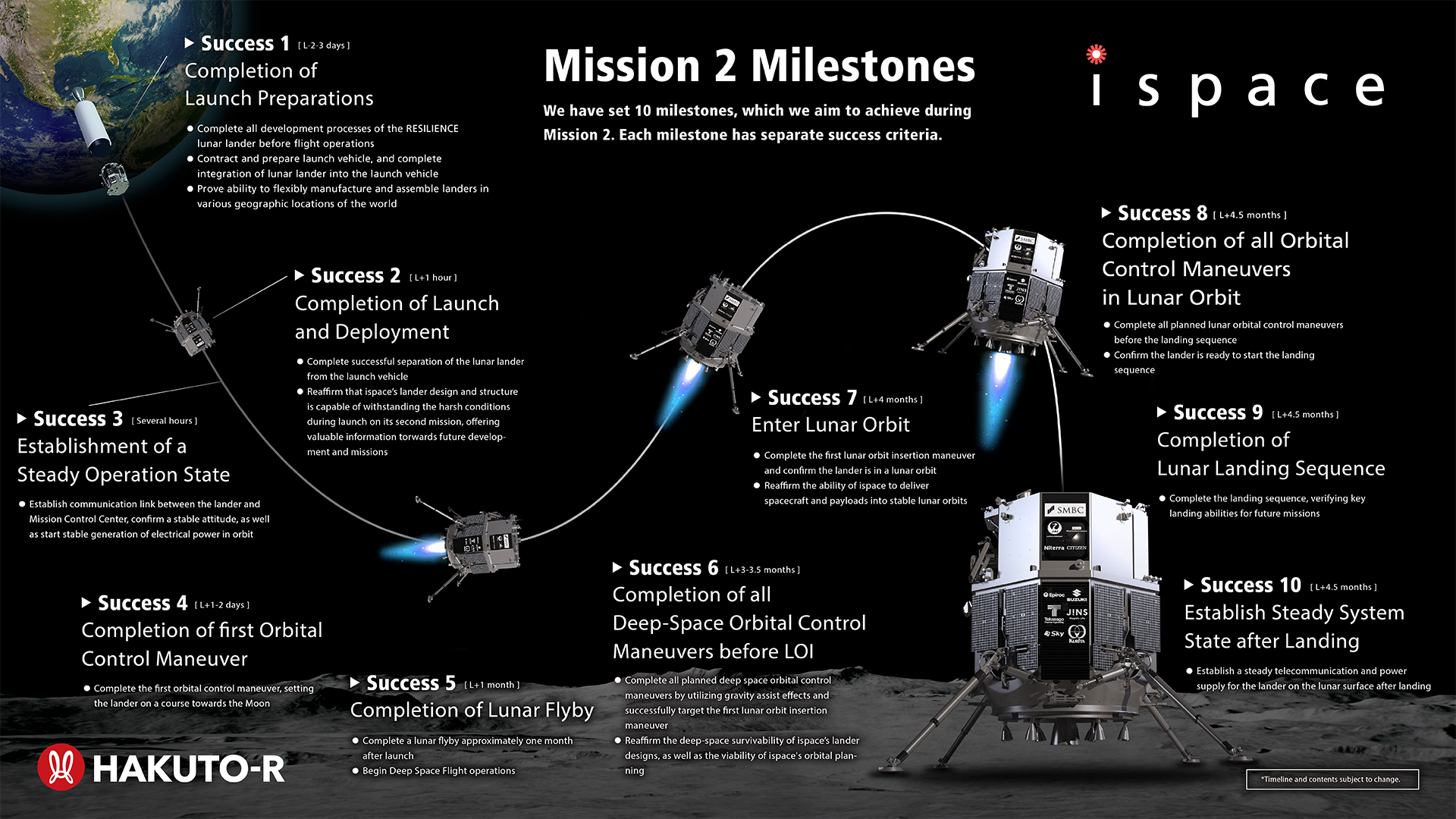
Now, fast-forward to this year, and NASA has half a dozen CLPS missions on its schedule. The first of these, Firefly Aerospace’s Blue Ghost Mission 1, launched on January 15 on a SpaceX Falcon 9 rocket. That same rocket also carried a lunar lander made by the Japanese company ispace, which is making a second attempt for its own commercial exploration endeavor, Hakuto-R.
Firefly’s lander, Blue Ghost, is expected to arrive at the moon first, with a target landing date of March 2 in an area called Mare Crisium. The 6.6-foot-tall solar-powered spacecraft is carrying 10 science payloads for NASA and other partners. That includes a new dust shield system to demonstrate how future missions might prevent particulates from accumulating on spacecraft, instruments for testing sample collection and Global Navigation Satellite System (GNSS)-based navigation and a radiation tolerant computer. “The objectives of the mission are to investigate heat flow from the lunar interior, plume-surface interactions, [and] crustal electric and magnetic fields,” according to NASA. “It will also take X-ray images of the Earth's magnetosphere.”
Resilience, the ispace lander, is taking a different, low-energy path to the moon and won’t reach its site, Mare Frigoris, until late May or June. That craft has a micro rover called Tenacious on board that is designed to explore, collect surface material and relay data. In addition to a camera and shovel, Tenacious has a tiny model house mounted on it — specifically the “Moonhouse,” by Swedish artist Mikael Genberg. The lander is carrying water electrolyzer equipment, a deep space radiation probe and a food production experiment module. (And how could we forget, it also contains a commemorative alloy plate from Bandai Namco Research Institute made in the style of the Gundam franchise’s “Charter of the Universal Century”).
ispace
Intuitive Machines, the company that pulled off the first-ever commercial moon landing with its Odysseus craft last year, is slated to launch its second CLPS mission in the next month or so, around the end of February. The IM-2 Nova-C lander dubbed Athena is headed to the lunar south pole with a meter-long drill and a mass spectrometer for NASA’s Polar Resources Ice Mining Experiment-1 (PRIME-1). Its goal is to demonstrate the feasibility of drilling for samples and analyzing those samples on-site for things like water. IM-2 will also serve as a rideshare for NASA’s Lunar Trailblazer, a small orbiter that will “study the form, abundance and distribution of lunar water and its relation to geology.”
Besides the PRIME-1 instruments, Athena will transport a laser retroreflector array, an Intuitive Machines Micro-Nova Hopper — described as “a propulsive drone that deploys off of a Nova-C lander and hops across the lunar surface” — and a Lunar Surface Communication System “network in a box” made by Nokia. The two companies plan to set up the moon’s first cellular network, which is “engineered to handle surface connectivity between the lander and vehicles, carrying high-definition video streaming, command-and-control communications and telemetry data.”
Intuitive Machines
There’s a chance Blue Origin’s Blue Moon Mark 1 lunar lander will take its first trip to the moon as soon as this spring or summer. John Couluris, a senior VP at Blue Origin, said in an interview with 60 Minutes last March that “we’re expecting to land on the moon between 12 and 16 months from today.” At the time, the company hadn’t yet launched its New Glenn rocket — which would be the vehicle for this mission — even once, so that claim didn’t hold much weight. But after many, many delays, New Glenn finally took its maiden flight in mid-January.
NASA revealed, in an FCC filing spotted by SpaceNews back in August, that it had selected Blue Origin’s lander to bring a camera system, the Stereo Cameras for Lunar Plume Surface Studies (SCALPSS), to the moon’s south pole this year under the CLPS program. In the filing, NASA notes that this needs to be done before 2025 is over, as the data collected by the instrument at landing will help inform plans for the first crewed Artemis moon landing. SCALPSS payloads have flown on other CLPS missions, but the thrust level of Blue Origin’s Mark 1 lander is closer to the scale of the Human Landing System NASA will use for astronauts.
Blue Origin said in another FCC filing the same month that its demonstration lunar mission, Pathfinder, could launch as early as March 2025, SpaceNews reported. Don’t be surprised if it actually happens much later.
The next CLPS mission after that isn’t expected to take off until the fall, when Astrobotic will get another shot at landing on the moon. This time, it’ll be sending its larger Griffin lander to a region near the south pole. Griffin Mission 1 was initially supposed to carry NASA’s Volatiles Investigating Polar Exploration Rover (VIPER), but the space agency canceled development of that project late last year due to delays and rising costs. Astrobotic’s lander won’t show up to the moon empty-handed, though. It’ll have a tiny solar-powered CubeRover in tow, as well as a laser retroreflector array to pinpoint the lander’s location.
Astrobotic
We may see a third Intuitive Machines mission before the end of this year. The company and NASA are eyeing late 2025 or early 2026 for the launch of IM-3, which will deliver a suite of instruments focused on studying the magnetic and plasma properties of the Reiner Gamma lunar swirl, an area with its own “mini-magnetosphere.” A rover called the Mobile Autonomous Prospecting Platform (MAPP) will also be on board, plus a trio of small rovers from the Cooperative Autonomous Distributed Robotic Exploration (CADRE) project that will demonstrate mostly autonomous robots working together. The European Space Agency’s MoonLIGHT laser retroreflector will fly with IM-3 too, along with and the Lunar Space Environment Monitor, from South Korea’s Korea Astronomy and Space Science Institute (KASI).
While this year is certain to bring a lot of activity on and around the moon, there’s one thing we won’t see there just yet — humans. NASA has adjusted the timeline of the Artemis missions a few times since the program’s announcement, and most recently said in December that it’s pushing the first crewed flight, Artemis II, to April 2026. The agency previously said it was shooting for September 2025. Artemis III, the mission in which two astronauts will go to the lunar surface, now isn’t expected to launch until mid-2027.
This article originally appeared on Engadget at https://ift.tt/BpINyeAfrom Engadget is a web magazine with obsessive daily coverage of everything new in gadgets and consumer electronics https://ift.tt/BpINyeA