Waffle House is one of those uniquely American institutions-turned-meme. The 24/7 chain is not only a place where you can order a breakfast combo at 3AM, but where unruly customers have been known to show up ready to throw hands (and sometimes chairs). Given its notoriety for late-night brawls, it’s exactly the type of setting that would make for a perfect backdrop in a fighting game like Tekken 8 — and apparently, fans have been inquiring. Longtime Tekken director Katsuhiro Harada posted on X this weekend asking what the deal is with all the Waffle House requests.
Obviously, the question was posed in the days before April Fools’ Day, so I wouldn’t be surprised if there turned out to be some jest baked into it all. But now that we’re having the conversation…
Ok, I will only ask once about this request.
Why do some communities send me requests for "Waffle House"?
Please be sure to explain the basis for the request, including the original story, history and background.
“Ok, I will only ask once about this request,” Harada posted. “Why do some communities send me requests for ‘Waffle House’? Please be sure to explain the basis for the request, including the original story, history and background. I look forward to an explanation from someone who knows more.”
Harada followed it up with another post thanking everyone who explained it and saying he understands, but went on to say, “The restaurant has both the trademark and the rights to the restaurant, so if the restaurant chain's headquarters refuses to accept my proposal, it will not happen.” Waffle House now has an opportunity to do something pretty funny here.
But that shouldn’t come before Waffle House adequately addresses the concerns of its employees, some of whom have been vocal in the last year about low wages and a lack of security. Employees from some locations are on strike, and the Union of Southern Service Workers has put together a petition demanding Waffle House implement changes to improve working conditions. Until that's resolved, any collaboration with the fighting game would just be in poor taste.
This article originally appeared on Engadget at https://ift.tt/3UB9nrl
from Engadget is a web magazine with obsessive daily coverage of everything new in gadgets and consumer electronics https://ift.tt/3UB9nrl
An AI chatbot released by the New York City government to help business owners access pertinent information has been spouting falsehoods, at times even misinforming users about actions that are against the law, according to a report from The Markup. The report, which was co-published with the local nonprofit newsrooms Documented and The City, includes numerous examples of inaccuracies in the chatbot’s responses to questions relating to housing policies, workers’ rights and other topics.
Mayor Adams’ administration introduced the chatbot in October as an addition to the MyCity portal, which launched in March 2023 as “a one-stop shop for city services and benefits.” The chatbot, powered by Microsoft’s Azure AI, is aimed at current and aspiring business owners, and was billed as a source of “actionable and trusted information” that comes directly from the city government’s sites. But it is a pilot program, and a disclaimer on the website notes that it “may occasionally produce incorrect, harmful or biased content.”
In The Markup’s tests, the chatbot repeatedly provided incorrect information. In response to the question, “Can I make my store cashless?”, for example, it replied, “Yes, you can make your store cashless in New York City” — despite the fact that New York City banned cashless stores in 2020. The report shows the chatbot also responded incorrectly about whether employers can take their workers’ tips, whether landlords have to accept section 8 vouchers or tenants on rental assistance, and whether businesses have to inform staff of scheduling changes. A housing policy expert that spoke to The Markup called the chatbot “dangerously inaccurate” at its worst.
The city has indicated that the chatbot is still a work in progress. In a statement to The Markup, Leslie Brown, a spokesperson for the NYC Office of Technology and Innovation, said the chatbot “has already provided thousands of people with timely, accurate answers,” but added, “We will continue to focus on upgrading this tool so that we can better support small businesses across the city.”
This article originally appeared on Engadget at https://ift.tt/FZip8Iv
from Engadget is a web magazine with obsessive daily coverage of everything new in gadgets and consumer electronics https://ift.tt/FZip8Iv
AT&T says 7.6 million current customers were affected by a recent leak in which sensitive data was released on the dark web, along with 65.4 million former account holders. TechCrunch first reported on Saturday morning that the company has reset the passcodes of all affected active accounts, and AT&T confirmed the move in an update published on its support page. The data set, which AT&T says “appears to be from 2019 or earlier,” includes names, home addresses, phone numbers, dates of birth and Social Security numbers, according to TechCrunch.
TechCrunch reports that it alerted AT&T about the potential for the leaked data to be used to access customers accounts on Monday, after a security researcher discovered that the records included easily decipherable encrypted passcodes. AT&T said today that it’s “launched a robust investigation supported by internal and external cybersecurity experts.” The data appeared on the dark web about two weeks ago, according to AT&T.
It comes three years after a hacker known as ShinyHunters claimed in 2021 that they’d obtained the account data of 73 million AT&T customers. AT&T at the time told BleepingComputer that it had not suffered a breach and that samples of information shared by the hacker online did “not appear to have come from our systems.” The company now says that “it is not yet known whether the data in those fields originated from AT&T or one of its vendors.” So far, it “does not have evidence of unauthorized access to its systems resulting in exfiltration of the data set.”
AT&T says it will reach out to both current and former account holders who have been affected by the leak. The company also says it will offer credit monitoring to those customers “where applicable.”
This article originally appeared on Engadget at https://ift.tt/2yK4u0p
from Engadget is a web magazine with obsessive daily coverage of everything new in gadgets and consumer electronics https://ift.tt/2yK4u0p
In 2014, WIRED asked me to write a few lines about my most-used app as part of an internship application. I wrote about WhatsApp because it was a no-brainer. I was an international student from India, and it was my lifeline to my family and to my girlfriend, now my wife, who lived on the other side of the world. “This cross-platform messenger gets all the credit for my long-distance relationship of two years, which is still going strong,” I wrote in my application. “Skype is great, Google+ Hangouts are the best thing to have happened since Gmail but nothing says ‘I love you’ like a WhatsApp text message.”
A few months into that internship, Facebook announced it was buying WhatsApp for a staggering $19 billion. In WIRED’s newsroom, there were audible gasps at this seemingly minor player's price tag. American journalists weren’t exactly unfamiliar with WhatsApp. Much of the country was still locked in a battle between green and blue bubbles, even as the rest of the world had switched to an app created by two former Yahoo! engineers in WIRED’s Mountain View backyard.
Text messaging was one of the few things you could do on WhatsApp in 2014. There were no emoji you could react with, no high-definition videos you could send, no GIFs or stickers, no read receipts until the end of that year and certainly no voice or video calling. And yet, more than 500 million people around the world were hooked, reveling in the freedom of using nascent cellular data to swap unlimited messages with friends and family instead of paying mobile carriers per text.
WhatsApp’s founders, Jan Koum and Brian Acton, launched the app in 2009 simply to display status messages next to people’s names in a phone’s contact book. But after Apple introduced push notifications on the iPhone later that year, it evolved into a full-blown messaging service. Now, 15 years later, WhatsApp has become a lot more — an integral part of the propaganda machinery of political parties in India and Brazil, a way for millions of businesses to reach customers, a way to send money to people and merchants, a distribution platform for publications, brands and influencers, a video conferencing system and a private social network for older adults. And it is still a great way for long-distance lovers to stay connected.
“WhatsApp is kind of like a media platform and kind of like a messaging platform, but it’s also not quite those things,” Surya Mattu, a researcher at Princeton who runs the university’s Digital Witness Lab, which studies how information flows through WhatsApp, told Engadget. “It has the scale of a social media platform, but it doesn’t have the traditional problems of one because there are no recommendations and no social graph.”
Indeed, WhatsApp’s scale dwarfs nearly every social network and messaging app out there. In 2020, WhatsApp announced it had more than two billion users around the world. It’s bigger than iMessage (1.3 billion users), TikTok (1 billion), Telegram (800 million), Snap (400 million) and Signal (40 million.) It stands head and shoulders above fellow Meta platform Instagram, which captures around 1.4 billion users. The only thing bigger than WhatsApp is Facebook itself, with more than three billion users .
WhatsApp has become the world’s default communications platform. Ten years after it was acquired, its growth shows no sign of stopping. Even in the US, it is finally beginning to break through the green and blue bubble battles and is reportedly one of Meta’s fastest-growing services. As Meta CEO Mark Zuckerberg told the New York Times last year, WhatsApp is the “next chapter” for the company.
Will Cathcart, a longtime Meta executive, who took over WhatsApp in 2019 after its original founders departed the company, credits WhatsApp’s early global growth to it being free (or nearly free — at one point, WhatsApp charged people $1 a year), running on almost any phone, including the world’s millions of low-end Android devices, reliably delivering messages even in large swathes of the planet with suboptimal network conditions and, most importantly, was dead simple, free of the bells and whistles that bloat most other messaging apps. In 2013, a year before Facebook acquired it, WhatsApp added the ability to send short audio messages.
“That was really powerful,” Cathcart told Engadget, “People who don’t have high rates of literacy or someone new to the internet could spin up WhatsApp, use it for the first time and understand it.”
In 2016, WhatsApp added end-to-end encryption, something Cathcart said was a huge selling point. The feature made WhatsApp a black box, hiding the contents of messages from everyone — even WhatsApp — except the sender and the receiver. The same year, WhatsApp announced that one billion people were using the service every month.
That explosive growth came with a huge flip side: As hundreds of millions of people in heavily populated regions, like Brazil and India, came online for the first time, thanks to inexpensive smartphone and data prices, WhatsApp became a conduit for hoaxes and misinformation to flow freely. In India, currently WhatsApp’s largest market with more than 700 million users, the app overflowed with propaganda and disinformation against opposition political parties, cheerleading Narendra Modi, the country’s nationalist Prime Minister accused of destroying its secular fabric.
Then people started dying. In 2017 and 2018, frenzied mobs in remote parts of the country high on baseless rumors about child abductors forwarded through WhatsApp, lynched nearly two dozen people in 13 separate incidents. In response to the crisis, WhatsApp swung into action. Among other things, it made significant product changes, such as clearly labeling forwarded messages — the primary way misformation spread across the service — as well as severely restricting the number of people and groups users could forward content to at the same time.
In Brazil, the app is widely seen as a key tool in the country’s former President Jair Bolsonaro’s 2018 win. Bolsonaro, a far-right strongman, was accused of getting his supporters to circumvent WhatsApp’s spam controls to run elaborate misinformation campaigns, blasting thousands of WhatsApp messages attacking his opponent, Fernando Haddad.
Since these incidents, WhatsApp has established fact-checking partnerships with more than 50 fact-checking organizations globally (because WhatsApp is encrypted, fact-checkers depend on users reporting messages to their WhatsApp hotlines and respond with fact checks). It also made additional product changes, like letting users quickly Google a forwarded message to fact-check it within the app. “Over time, there might be more things we can do,” said Cathcart, including potentially using AI to help with WhatsApp’s fact-checking. “There’s a bunch of interesting things we could do there, I don’t think we’re done,” he said.
Recently, WhatsApp has rapidly added new features, such as the ability to share large files, messages that auto-destruct after they’re viewed, Instagram-like Stories (called Statuses) and larger group calls, among other things. But a brand new feature rolled out globally in fall 2023 called Channels points to WhatsApp’s ambitions to become more than a messaging app. WhatsApp described Channels, in a blog post announcing the launch, as “a one-way broadcast tool for admins to send text, photos, videos, stickers and polls.” They’re a bit like a Twitter feed from brands, publishers and people you choose to follow. It has a dedicated tab in WhatsApp, although interaction with content is limited to responding with emoji — no replies. There are currently thousands of Channels on WhatsApp and 250-plus have more than a million followers each, WhatsApp told Engadget. They include Puerto Rican rapper Bad Bunny (18.9 million followers), Narendra Modi (13.8 million followers), FC Barcelona (27.7 million followers) and the WWE (10.9 million followers). And even though it’s early days, Channels is fast becoming a way for publishers to distribute their content and build an audience.
“It took a year for us to grow to an audience of 35,000 on Telegram,” Rachel Banning-Lover, the head of social media and development at the Financial Times (155,000 followers) toldNieman Lab in November. “Comparatively, we [grew] a similar-sized following [on WhatsApp] in two weeks.”
WhatsApp’s success at consistently adding new functionality without succumbing to feature sprawl has allowed it to thrive, both with its core audience and also, more recently, with users in the US. According to data that analytics firm Data.ai shared with Engadget, WhatsApp had nearly 83 million users in the US in January 2024, compared to 80 million a year before. A couple of years ago, WhatsApp ran an advertising campaign in the US — its first in the country — where billboards and TV spots touted the app’s focus on privacy.
It’s a sentiment shared by Zuckerberg himself, who, in 2021, shared a “privacy-focused vision for social networking” on his Facebook page. “I believe the future of communication will increasingly shift to private, encrypted services where people can be confident that what they say to each other stays secure and their messages and content won’t stick around,” he wrote. “This is the future I hope we will help bring about.”
Meta has now begun using WhatsApp’s sheer scale to generate revenue, although it’s unclear so far how much money, if any, the app makes. “The business model we’re really excited about and one that we’ve been growing for a couple of years successfully is helping people talk to businesses on WhatsApp,” Cathcart said. “That’s a great experience.” Meta monetizes WhatsApp by charging large businesses to integrate the platform directly into existing systems they use to manage interactions with customers. And it integrates the whole system with Facebook, allowing businesses to place ads on Facebook that, when clicked, open directly to a WhatsApp chat with the business. These have become the fastest-growing ad format across Meta, the company told The New York Times.
A few years ago, a configuration change in Facebook’s internal network knocked multiple Facebook services, including WhatsApp, off the internet for more than six hours and ground the world to a halt.
“It’s like the equivalent of your phone and the phones of all of your loved ones being turned off without warning. [WhatsApp] essentially functions as an unregulated utility,” journalist Aura Bogado reportedly wrote on then-Twitter. In New Delhi and Brazil, gig workers were unable to reach customers and lost out on wages. In London, crypto trades stopped as traders were unable to communicate with clients. One firm claimed a drop of 15 percent. In Russia, oil markets were hit after traders were unable to get in touch with buyers in Europe and Asia placing orders.
Fifteen years after it was created, the messaging app runs the world.
To celebrateEngadget's 20th anniversary, we're taking a look back at the products and services that have changed the industry since March 2, 2004.
This article originally appeared on Engadget at https://ift.tt/jXwZtDb
from Engadget is a web magazine with obsessive daily coverage of everything new in gadgets and consumer electronics https://ift.tt/jXwZtDb
Elon Musk's answer to ChatGPT is getting an update to make it better at math, coding and more. Musk's xAI has launched Grok-1.5 to early testers with "improved capabilities and reasoning" and the ability to process longer contexts. The company claims it now stacks up against GPT-4, Gemini Pro 1.5 and Claude 3 Opus in several areas.
Going by xAI's numbers, Grok-1.5 appears to be a large improvement over Grok-1. It shot up to 50.6 percent in the MATH benchmark, over double the previous score. It also climbed to 90 percent and 74.1 percent in GSM8K (math word problems) and HumanEval (coding), respectively, compared to 62.9 percent and 63.2 percent before. Those numbers are within shouting distance of Gemini Pro 1.5, GPT-4 and Claude 3 Opus — in fact, the HumanEval coding score beats all rivals except Claude 3 Opus.
xAI
It can also process long contexts of up to 128K tokens within its context window, meaning it can amalgamate data from more sources to understand a situation. "This allows Grok to have an increased memory capacity of up to 16 times the previous context length, enabling it to utilize information from substantially longer documents," the company said.
xAI didn't detail Grok's progress in other areas, though, where it still may be lagging (academic scores, multimodal and others). And Grok-1.5 may not keep its position for long. ChatGPT 5 is set to arrive sometime this summer, promising a feature set that "makes it feel like you are communicating with a person rather than a machine," according to OpenAI.
Currently, Grok is only available for users of the Premium+ tier on X (formerly Twitter), though Elon Musk recently promised to open it up to X's regular Premium users. The company also recently open sourced its Grok chatbot, after Musk sued OpenAI and Sam Altman for allegedly abandoning its non-profit mission.
This article originally appeared on Engadget at https://ift.tt/7elLMpr
from Engadget is a web magazine with obsessive daily coverage of everything new in gadgets and consumer electronics https://ift.tt/7elLMpr
No more Fortnite Twitch streams on butts. I said what I said. If you're out of the loop on all things Twitch, there's a trend going around of streamers projecting their gameplays on green-screened body parts, usually intimate ones like butts and breasts. Because normal picture-in-picture is now apparently too boring. Twitch is putting a stop to its streamers' shenanigans, though, and will officially prohibit "content that focuses on clothed intimate body parts such as the buttocks, groin, or breasts for extended periods of time" starting on March 29.
Our Community Guidelines are designed to help make Twitch a welcoming place. Content on Twitch is always evolving, and we want to make sure our rules work as intended and keep up with emerging behaviors. When needed, we make updates to our rules to capture those shifts in…
In a writeup on the trend, Kotaku explained that it all started when controversial streamer Morgpie projected her Fortnite gaming session on a closeup of her behind. After that, other streamers followed suit, overlaying their games on body parts both real and fictional, like anime thighs or anime boobs breasting boobily on screen while they're playing. Now, boobs and butts streaming is out. Don't get caught up on the "clothed intimate body parts" wording, as well — of course, their unclothed versions are also prohibited, as per Twitch's policy that doesn't allow users to broadcast or upload "content that contains depictions of real or fictional nudity, regardless of the medium used to create it."
Twitch had previously revised its guidelines due to Morgpie's activities on its platform. The streamer went live with a well-positioned camera that suggested she was gaming topless, shortly after Twitch relaxed its rules for sexual content on the platform. It gave rise to a meta of streamers pretending to be unclothed, prompting the platform to rescind those policy changes and ultimately to bar users from pretending to be fully or partially nude in their streams.
It's been five months since President Joe Biden signed an executive order (EO) to address the rapid advancements in artificial intelligence. The White House is today taking another step forward in implementing the EO with a policy that aims to regulate the federal government's use of AI. Safeguards that the agencies must have in place include, among other things, ways to mitigate the risk of algorithmic bias.
"I believe that all leaders from government, civil society and the private sector have a moral, ethical and societal duty to make sure that artificial intelligence is adopted and advanced in a way that protects the public from potential harm while ensuring everyone is able to enjoy its benefits," Vice President Kamala Harris told reporters on a press call.
Harris announced three binding requirements under a new Office of Management and Budget (OMB) policy. First, agencies will need to ensure that any AI tools they use "do not endanger the rights and safety of the American people." They have until December 1 to make sure they have in place "concrete safeguards" to make sure that AI systems they're employing don't impact Americans' safety or rights. Otherwise, the agency will have to stop using an AI product unless its leaders can justify that scrapping the system would have an "unacceptable" impact on critical operations.
Impact on Americans' rights and safety
Per the policy, an AI system is deemed to impact safety if it "is used or expected to be used, in real-world conditions, to control or significantly influence the outcomes of" certain activities and decisions. Those include maintaining election integrity and voting infrastructure; controlling critical safety functions of infrastructure like water systems, emergency services and electrical grids; autonomous vehicles; and operating the physical movements of robots in "a workplace, school, housing, transportation, medical or law enforcement setting."
Unless they have appropriate safeguards in place or can otherwise justify their use, agencies will also have to ditch AI systems that infringe on the rights of Americans. Purposes that the policy presumes to impact rights defines include predictive policing; social media monitoring for law enforcement; detecting plagiarism in schools; blocking or limiting protected speech; detecting or measuring human emotions and thoughts; pre-employment screening; and "replicating a person’s likeness or voice without express consent."
When it comes to generative AI, the policy stipulates that agencies should assess potential benefits. They all also need to "establish adequate safeguards and oversight mechanisms that allow generative AI to be used in the agency without posing undue risk."
Transparency requirements
The second requirement will force agencies to be transparent about the AI systems they're using. "Today, President Biden and I are requiring that every year, US government agencies publish online a list of their AI systems, an assessment of the risks those systems might pose and how those risks are being managed," Harris said.
As part of this effort, agencies will need to publish government-owned AI code, models and data, as long as doing so won't harm the public or government operations. If an agency can't disclose specific AI use cases for sensitivity reasons, they'll still have to report metrics
ASSOCIATED PRESS
Last but not least, federal agencies will need to have internal oversight of their AI use. That includes each department appointing a chief AI officer to oversee all of an agency's use of AI. "This is to make sure that AI is used responsibly, understanding that we must have senior leaders across our government who are specifically tasked with overseeing AI adoption and use," Harris noted. Many agencies will also need to have AI governance boards in place by May 27.
The vice president added that prominent figures from the public and private sectors (including civil rights leaders and computer scientists) helped shape the policy along with business leaders and legal scholars.
The OMB suggests that, by adopting the safeguards, the Transportation Security Administration may have to let airline travelers opt out of facial recognition scans without losing their place in line or face a delay. It also suggests that there should be human oversight over things like AI fraud detection and diagnostics decisions in the federal healthcare system.
As you might imagine, government agencies are already using AI systems in a variety of ways. The National Oceanic and Atmospheric Administration is working on artificial intelligence models to help it more accurately forecast extreme weather, floods and wildfires, while the Federal Aviation Administration is using a system to help manage air traffic in major metropolitan areas to improve travel time.
"AI presents not only risk, but also a tremendous opportunity to improve public services and make progress on societal challenges like addressing climate change, improving public health and advancing equitable economic opportunity," OMB Director Shalanda Young told reporters. "When used and overseen responsibly, AI can help agencies to reduce wait times for critical government services to improve accuracy and expand access to essential public services."
This policy is the latest in a string of efforts to regulate the fast-evolving realm of AI. While the European Union has passed a sweeping set of rules for AI use in the bloc, and there are federal billsin the pipeline, efforts to regulate AI in the US have taken more of a patchwork approach at state level. This month, Utah enacted a law to protect consumers from AI fraud. In Tennessee, the Ensuring Likeness Voice and Image Security Act (aka the Elvis Act — seriously) is an attempt to protect musicians from deepfakes i.e. having their voices cloned without permission.
This article originally appeared on Engadget at https://ift.tt/oFg30OR
from Engadget is a web magazine with obsessive daily coverage of everything new in gadgets and consumer electronics https://ift.tt/oFg30OR
Apple’s 35th annual Worldwide Developers Conference (WWDC) is June 10 to 14. WWDC is typically a software-centric event, so it’s highly likely we’ll get our first look at iOS 18, iPadOS 18, tvOS 18, macOS 15 and watchOS 11. It may also be a good chance for Apple to upgrade its visionOS software for Vision Pro.
There may be hardware too. Last year’s WWDC included a detailed presentation on the Vision Pro and the 15-inch M2 MacBook Air. This year? Another Vision Pro? A Mac Mini? Place your bets.
Game Help shared developer-created tips and videos for PS5 games, bubbling up advice depending on where you were in a game. Unfortunately, in my experience, it was rarely useful advice. That might improve soon, as Sony adds videos from other gamers for those tricky bosses and segments. Community tips will be accessible in the same way as Game Help: click the PS button, launch the Control Center and find an Action Card labeled Hints Inside. Any card with gamer videos will have a Community Game Help label and players will be able to rate tips’ usefulness.
Microsoft is bringing together its Windows experiences and devices teams into one division. Pavan Davuluri, who’s been head of the Surface team since last year, will now also lead Windows experiences after Mikhail Parakhin’s departure. Perhaps interestingly, Parakhin vacated his role a week after Microsoft hired DeepMind co-founder Mustafa Suleyman, who apparently asked Parakhin to report to him directly.
Scientists have created a scientific camera that shoots images at an encoding rate of 156.3 terahertz (THz) to individual pixels — equivalent to 156.3 trillion frames per second. Dubbed SCARF (swept-coded aperture real-time femtophotography), the research-grade camera could lead to breakthroughs in fields studying micro-events impossible to capture on existing scientific imaging equipment. SCARF could open new frontiers in areas as diverse as shock wave mechanics or the development of more effective medicine.
We had the first wave of changes and tweaks to Apple, Google and other big tech companies’ policies and services just before the EU’s sweeping Digital Markets Act (DMA) took a harder line against monopolistic behaviors and practices. See: third-party app stores with Apple, the option to pay for Facebook (haha!), the ability to choose your own default browser, search engine, and more.
But the EU isn't quite satisfied. Alphabet and Apple, says the European Commission, have not sufficiently allowed “app developers to ‘steer’ consumers to offers outside the gatekeepers’ app stores, free of charge.”
The EC says Alphabet might still be leading users to Google-owned services like Google Flights. Apple may not be allowing users meaningful choice in selecting alternatives to default iOS services or preferences, such as the ability to uninstall any preloaded app.
In January, Apple announced changes to the App Store to comply with the DMA, including the ability to use alternative app marketplaces on iOS in the EU. Included in Apple’s updates was a new “core technology fee” of €0.50 developers will have to pay per user per year after the first million installs of an app — even if a user downloads the software from a third-party marketplace. Many of Apple’s rivals aren’t happy about the App Store changes. Some criticized the company’s fees for third-party payments in the US too.
Florida Governor Ron DeSantis just signed a bill into law with far stricter rules on how kids under 16 can use and access social media. The bill requires a parent or guardian’s consent for 14- and 15-year-olds to make an account or use a pre-existing account on a social media platform. The companies behind these platforms must also abide by requests to delete these accounts within five business days. Failing to do so could rack up major fines, as much as $10,000 for each violation. The bill doesn’t name any specific social media platforms but suggests any service that promotes “infinite scrolling” will have to follow the new rules. So yeah, the usual suspects.
Spotify has teamed up with content partners BBC Maestro, PLAYvirtuoso, Thinkific Labs Inc. and Skillshare to offer content in making music, getting creative, learning business and living healthily. The test courses are available only to UK users, with free and premium subscribers receiving at least two free lessons per course. The series will range from £20 ($25) to £80 ($101), regardless of a person’s subscription tier. The course content seems to be somewhere between Masterclass and LinkedIn Learning — make of that what you will.
Last summer, TikTok said it planned to form a “youth council” of teens to advise the company as part of a broader push to beef up safety features for the app’s youngest users. That group is now official, just as TikTok contends with a bill that would force parent-company ByteDance to sell the app or face a ban in the United States. While it’s unclear how much influence TikTok’s youth council will ultimately wield over the company’s policies, it underscores just how important teens are to the platform. The company has tried to mobilize its users, many of them teens, to oppose the bill being discussed by the US government.
Microsoft is bringing together its Windows experiences and its Windows devices teams to form one division, and it has appointed company veteran Pavan Davuluri with the task of leading it. As The Verge notes, Davuluri has been serving as head of the Surface team since last year, after Microsoft split up Windows experiences and devices following Panos Panay's departure. The company is expanding his role again after another departure, this time of former Windows experiences lead Mikhail Parakhin, who was in charge of the Bing search engine and its advertising business.
In a letter written by Rajesh Jha and obtained by the publication, the company's technology chief said Parakhin "has decided to explore new roles." It's not quite clear if he's leaving Microsoft altogether or is still exploring for new opportunities within the company. But it's worth noting that he decided to vacate his role a week after Microsoft hired Deepmind co-founder Mustafa Suleyman, who apparently asked Parakhin to report to him directly. For now, Parakhin is still with Microsoft and will report to company CTO Kevin Scott during the transition period.
Jha wrote in his letter that merging the two teams will enable the company to "take a holistic approach to building silicon, systems, experiences, and devices that span Windows client and cloud for this AI era." While Davuluri now heads both web experiences and devices team, the former is still required to report to Suleyman, who's in charge of Microsoft's AI efforts.
This article originally appeared on Engadget at https://ift.tt/7yK4Ubu
from Engadget is a web magazine with obsessive daily coverage of everything new in gadgets and consumer electronics https://ift.tt/7yK4Ubu
The Oversight Board is urging Meta to change the way it moderates the word “shaheed,” an Arabic term that has led to more takedowns than any other word or phrase on the company’s platforms. Meta asked the group for help crafting new rules last year after attempts to revamp it internally stalled.
The Arabic word “shaheed” is often translated as “martyr,” though the board notes that this isn’t an exact definition and the word can have “multiple meanings.” But Meta’s current rules are based only on the “martyr” definition, which the company says implies praise. This has led to a “blanket ban” on the word when used in conjunction with people designated as “dangerous individuals” by the company.
However, this policy ignores the “linguistic complexity” of the word, which is “often used, even with reference to dangerous individuals, in reporting and neutral commentary, academic discussion, human rights debates and even more passive ways,” the Oversight Board says in its opinion. “There is strong reason to believe the multiple meanings of ‘shaheed’ result in the removal of a substantial amount of material not intended as praise of terrorists or their violent actions.”
In their recommendations to Meta, the Oversight Board says that the company should end its “blanket ban” on the word being used to reference “dangerous individuals,” and that posts should only be removed if there are other clear “signals of violence” or if the content breaks other policies. The board also wants Meta to better explain how it uses automated systems to enforce these rules.
If Meta adopts the Oversight Board’s recommendations, it could have a significant impact on the platform’s Arabic-speaking users. The board notes that the word, because it is so common, likely “accounts for more content removals under the Community Standards than any other single word or phrase,” across the company’s apps.
“Meta has been operating under the assumption that censorship can and will improve safety, but the evidence suggests that censorship can marginalize whole populations while not improving safety at all,” the board’s co-chair (and former Danish prime minister) Helle Thorning-Schmidt said in a statement. “The Board is especially concerned that Meta’s approach impacts journalism and civic discourse because media organizations and commentators might shy away from reporting on designated entities to avoid content removals.”
This is hardly the first time Meta has been criticized for moderation policies that disproportionately impact Arabic-speaking users. A 2022 report commissioned by the company found that Meta’s moderators were less accurate when assessing Palestinian Arabic, resulting in “false strikes” on users’ accounts. The company apologized last year after Instagram’s automated translations began inserting the word “terrorist” into the profiles of some Palestinian users.
The opinion is also yet another example of how long it can take for Meta’s Oversight Board to influence the social network’s policies. The company first asked the board to weigh in on the rules more than a year ago (the Oversight Board said it “paused” the publication of the policy after October 7 attacks in Israel to ensure its rules “held up” to the “extreme stress” of the conflict in Gaza). Meta will now have two months to respond to the recommendations, though actual changes to the company’s policies and practices could take several more weeks or months to implement.
“We want people to be able to use our platforms to share their views, and have a set of policies to help them do so safely,” a Meta spokesperson said in a statement. “We aim to apply these policies fairly but doing so at scale brings global challenges, which is why in February 2023 we sought the Oversight Board's guidance on how we treat the word ‘shaheed’ when referring to designated individuals or organizations. We will review the Board’s feedback and respond within 60 days.”
This article originally appeared on Engadget at https://ift.tt/TgqIz9t
from Engadget is a web magazine with obsessive daily coverage of everything new in gadgets and consumer electronics https://ift.tt/TgqIz9t
According to Rabbit, the first batch of US pre-orders will ship on March 31. But stay patient, as it’ll take a few weeks for the devices to get to their destinations. The company estimates the first R1 orders will be in customers’ hands “around April 24.”
The Rabbit R1 generated equal amounts of hype and questions regarding next-gen AI hardware and whether it can deliver on the heady demos and press releases. I will say, though, the R1, co-designed by Teenage Engineering, is a pretty piece of tech.
The odds are fairly low that you’ll have to worry about it.
University security researchers found a chip-level exploit in Apple Silicon-powered Macs. The group says the flaw can bypass the computer’s encryption and access its security keys. However, hackers would need to circumvent Apple’s Gatekeeper protections, install a malicious app and let the software run for 10 hours — in addition to other complex conditions. As long as you have Apple’s Gatekeeper turned on (the default), you won’t be able to install such malicious apps anyway.
Lawmakers have participated in classified briefings about the app.
As the Senate considers a bill that would force the sale or ban of TikTok, lawmakers have heard directly from intelligence officials about the app’s alleged national security threat. Now, two senators are asking the office of the Director of National Intelligence to declassify and make public what the agency has shared.
Instead of a suggestive tease, spam bots in the Instagram universe are now more likely to post a single, inoffensive, completely irrelevant-to-the-subject word, sometimes accompanied by an emoji or two. That’s partially because Instagram’s word filters won’t catch them, but it’s simply a numbers game. Cheyenne MacDonald takes a closer look.
GKIDS and Fathom Events have announced the lineup for Studio Ghibli Fest 2024, and it’s absolutely stacked with gems. This year’s run includes 14 films and isn’t limited only to the works of Hayao Miyazaki, also featuring movies directed by Isao Takahata, Yoshifumi Kondo, Hiroyuki Morita and Hiromasa Yonebayashi. Studio Ghibli Fest 2024 will start with Spirited Away on April 27 and continue through December, when it ends with My Neighbor Totoro. The movies are playing in select AMC and Regal theaters across the US, with a few dates for each title in both Japanese and English dubbed.
The full list is: Spirited Away (April 27-May 1), Nausicaä of the Valley of the Wind (May 19 and 21), Castle in the Sky (May 20 and 22), The Secret World of Arrietty (June 9 and 11), When Marnie Was There (June 10 and 12), Princess Mononoke (July 13-17), Ponyo (August 3-7), Whisper of the Heart (August 25 and 27), The Cat Returns (August 26 and 28), Howl’s Moving Castle (September 26-October 3), Kiki’s Delivery Service (October 26-30), Pom Poko (November 24 and 26), The Tale of the Princess Kaguya (November 25 and 27), and My Neighbor Totoro (December 7-11).
I’m already crying thinking about watching Nausicaä and Princess Kaguya on the big screen. Actually, you can apply that sentiment to pretty much all of these titles. It’s going to be great. According to the announcement, there will also be “surprise special extra content.”
This article originally appeared on Engadget at https://ift.tt/iGXlYxH
from Engadget is a web magazine with obsessive daily coverage of everything new in gadgets and consumer electronics https://ift.tt/iGXlYxH
The newly independent game studio Toys for Bob, which announced last month that it was splitting from Microsoft-owned Activision, has entered an agreement with Xbox for a new game, according to a report from Windows Central. Toys for Bob developed 2018’s Spyro Reignited Trilogy and was behind Crash Bandicoot 4, along with the Nintendo Switch port for the N. Sane Trilogy.
There are no real details yet as to what the new title might be, aside from a comment by Xbox’s Matt Booty in a recent town hall meeting that it will be in line with the kind of games Toys for Bob has become known for, according to Windows Central. Toys for Bob also led the development of the early Skylanders toys-to-life games. Though it only recently departed from the Activision Blizzard/Microsoft family, the studio indicated leading up to the news of its deal with Xbox that it would remain open to working with its former employer on future projects.
In February, Toys for Bob said it was “exploring a possible partnership between our new studio and Microsoft,” and that it was “confident that we will continue to work closely together” with Activision and Microsoft. “So, keep your horns on and your eyes out for more news,” the studio wrote.
This article originally appeared on Engadget at https://ift.tt/iIWCjJs
from Engadget is a web magazine with obsessive daily coverage of everything new in gadgets and consumer electronics https://ift.tt/iIWCjJs
Sonos is readying the release of its followup to 2021’s Roam speaker, and it should be here in time for all your outdoor summer excursions. In the Power On newsletter this week, Bloomberg’s Mark Gurman says Sonos is planning a June release for the Roam 2 speaker. The first-generation Roam was Sonos’ second attempt at a portable speaker, with a slim, triangular build that weighs less than a pound but produces impressive sound.
According to Gurman, this version of the Roam will feature the same touch-sensitive control panel seen in some of the company’s other speakers, like the Era 100. Sonos is also reportedly working on a new app to pair with its devices, starting with the Roam 2 and an upcoming set of premium headphones that are positioned as an AirPods Max rival. Those headphones will cost $450, Gurman reports, and are also expected to be released in June a bit behind their original schedule.
This article originally appeared on Engadget at https://ift.tt/vJMak5f
from Engadget is a web magazine with obsessive daily coverage of everything new in gadgets and consumer electronics https://ift.tt/vJMak5f
Federal authorities in the US asked Google for the names, addresses, telephone numbers and user activity of the accounts that watched certain YouTube videos between January 1 and 8, 2023, according to unsealed court documents viewed by Forbes. People who watched those videos while they weren't logged into an account weren't safe either, because the government also asked for their IP addresses. The investigators reportedly ordered Google to hand over the information as part of an investigation into someone who uses the name "elonmuskwhm" online.
Authorities suspect that elonmuskwhm is selling bitcoin for cash and is, thus, breaking money laundering laws, as well as running an unlicensed money transmitting business. Undercover agents reportedly sent the suspect links to videos of YouTube tutorials for mapping via drones and augmented reality software in their conversations back in early January. Those videos, however, weren't private and had been collectively viewed by over 30,000 times, which means the government was potentially asking Google for private information on quite a large number of users. "There is reason to believe that these records would be relevant and material to an ongoing criminal investigation, including by providing identification information about the perpetrators," authorities reportedly told the company.
Based on the documents Forbes had seen, the court granted the order but had asked Google to keep it under wraps. It's also unclear if Google handed over the data the authorities were asking for. In another incident, authorities asked the company for a list of accounts that "viewed and/or interacted" with eight YouTube livestreams. Cops requested for that information after learning that they were being watched through a stream while they were searching an area following a report that an explosive was placed inside a trashcan. One of those video livestreams was posted by the Boston and Maine Live account, which has over 130,000 subscribers.
A Google spokesperson told Forbes that the company follows a "rigorous process" to protect the privacy of its users. But critics and privacy advocates are still concerned that government agencies are overstepping and are using their power to obtain sensitive information on people who just happened to watch specific YouTube videos and aren't in any way doing anything illegal.
"What we watch online can reveal deeply sensitive information about us—our politics, our passions, our religious beliefs, and much more," John Davisson, senior counsel at the Electronic Privacy Information Center, told Forbes. "It's fair to expect that law enforcement won't have access to that information without probable cause. This order turns that assumption on its head."
This article originally appeared on Engadget at https://ift.tt/ETUXFxd
from Engadget is a web magazine with obsessive daily coverage of everything new in gadgets and consumer electronics https://ift.tt/ETUXFxd
If you're in the US, you might see a new shaded section at the top of your Google Search results with a summary answering your inquiry, along with links for more information. That section, generated by Google's generative AI technology, used to appear only if you've opted into the Search Generative Experience (SGE) in the Search Labs platform. Now, according to Search Engine Land, Google has started adding the experience on a "subset of queries, on a small percentage of search traffic in the US." And that is why you could be getting Google's experimental AI-generated section even if you haven't switched it on.
The company introduced SGE at its I/O developer conference in May last year, shortly after it opened up access to its ChatGPT rival Bard, now called Gemini. By November, it had rolled out the feature to 120 countries with more languages other than English, but it still remained opt in. Search Engine Land says Google will start showing you the experience even if you haven't opted in if you look up complex queries or if it thinks you could benefit from getting information from multiple websites. "How do I get marks off painted walls," is apparently one example.
Google told the publication that for these tests, it will only show AI overviews if it has confidence that they will show information better than what Search results might surface. Apparently, the company is conducting these tests, because it wants to get feedback from more people, specifically from those who didn't choose to activate the feature. That way it can have a better idea of how generative AI can serve those who may not be tech-savvy or those who couldn't care less about generative AI.
This article originally appeared on Engadget at https://ift.tt/DEJndwm
from Engadget is a web magazine with obsessive daily coverage of everything new in gadgets and consumer electronics https://ift.tt/DEJndwm
The Department of Justice and more than a dozen states have filed a lawsuit against Apple in the US federal court, accusing the company of violating antitrust laws. It says Apple’s hardware and software products are largely inaccessible to competitors, making it difficult for rivals to compete and for customers to switch to other companies’ products.
The lawsuit comes after the European Commission fined Apple €1.8 billion ($1.95 billion) for stopping music-streaming developers from “informing iOS users about alternative and cheaper music subscription services available” outside the App Store. And all this while US lawmakers chase another tech company, TikTok, with a lot of enthusiasm.
The DOJ suggests Apple used its control over iOS to block innovative apps and cloud streaming services from the public. (Look at cloud gaming services, like Google’s now-gone Stadia and Microsoft’s xCloud). The suit also suggests Apple has obstructed rival payment platforms, made it harder for Android messages to appear on iPhones and restricted how competing smartphones integrated with iOS devices.
You could compare Apple’s antitrust suit to Microsoft’s antitrust suit brought against Windows in the late ’90s — even Attorney General Merrick Garland noted those in the suit. But Microsoft truly dominated PC software back then, with over 90 percent of all PCs running some flavor of Windows.
The DOJ says Apple claims 70 percent of all smartphones, which is already less. Step outside the US, which is a bit academic here, and Apple has the same market share as Samsung, with many other phone makers jostling for a percentage point or two. It’s not quite the same grip as Microsoft had on PCs.
Two devices conspicuously missing from Microsoft’s Surface and AI event last fall are finally here — and they’re what we expected and a bit surprising. Today, Microsoft unveiled the Surface Pro 10 and Surface Laptop 6, sporting the same designs as the previous models but now with the AI smarts of Intel’s new Core Ultra CPU. Alas, both have the foreboding words “for business” attached to their names, so you’ll only be able to buy them from Microsoft’s website or commercial resellers. But why? We don’t really know.
DoorDash just announced the launch of a new drone delivery pilot program in Christiansburg, Virginia, with an approximate population of 22,000. The company says orders should arrive in 30 minutes or less, making high-flying drones about as fast as a standard pizza delivery. However, it’s limited to only “eligible items.” And, alas, only items from fast-food chain Wendy’s.
The social media stalwart wants to raise around $631 million in its IPO.
Nearly two decades after its debut, Reddit is now a publicly traded company. It was listed on the New York Stock Exchange as RDDT on Thursday, with mascot Snoo on hand to ring the opening bell. One interesting aspect of Reddit going public is it offered shares at the IPO pricing to long-term users of good standing over the last few weeks. It’s not all good news for Reddit, though. It recently signed a deal with Google, reportedly worth $60 million a year, to train the latter’s AI models on user-generated content. The Federal Trade Commission is looking into that arrangement.
This week, we explain how to clean all your screens without damaging them. And, if we really stretch the spring-cleaning theme to include hygiene and then stretch again to sleep hygiene, here’s some technology to help you get a better rest, too.
Elon Musk announced the first human patient had received a Neuralink brain implant as part of the company’s first clinical trial earlier this year. And yesterday, the company briefly live streamed a demo on X of 29-year-old Nolan Arbaugh, who is paralyzed from the neck down, demonstrating the implant by moving a cursor around the screen of a laptop and pausing an on-screen music player. Arbaugh said the implant has allowed him to play chess and Civilization VI.
All those big names have joined Epic Games in protesting Apple’s decision to charge a fee for iOS payments made outside of the App Store. The company takes up to a 30 percent cut of App Store purchases. When developers process purchases outside of the App Store, Apple will charge a fee of up to 27 percent. That’s really not much different.
The four companies supporting Epic’s petition claim Apple’s fee on external payments effectively maintains the previous rules. “The Apple Plan comports with neither the letter nor the spirit of this Court’s mandate,” their brief states.
You’ll be able to stick with an event you’re into.
Peacock will host more than 5,000 hours of live coverage across the two weeks, including each of the 329 medal events. That’s far more than anyone could possibly watch during the Games, so to help you keep track of several events at once, Peacock is offering several multiview options. On TVs, tablets and desktop browsers (but not phones, sadly), you’ll be able to watch four matches at the same time. With the multiview modes, you can move the screens around, choose the audio track you want to listen to and click through to watch an event in full screen. Another feature, Peacock Live Actions, will help you follow the events you’re most interested in, so you can continue watching the sport on screen even after NBC’s broadcast switches elsewhere.
At the Consumer Electronics Show earlier this year, LG officially unveiled a curious little box-like projector that comes with a handle that kinda looked like a crank. Well that model, called the CineBeam Q, is now available for pre-order for $1,299 and will come with some extras and freebies if you make your purchase on or before April 7. LG called the CineBeam Q "one of the smallest projectors available" and one that was designed to be portable so that you could easily take it outdoors or indoors, depending on where you want to hold your projector watch party. As long as there's a power source, of course, since it does need to be plugged in.
Its display has a 4K UHD resolution, can go as big as 120 inches and has an RGB laser light source. The model comes with LG's webOS software, which means you can easily stream movies and shows from Netflix, YouTube, Apple TV, Prime Video and Disney+. You can also use it to play media from your other devices, since it's compatible with Apple AirPlay 2 and screen share, as well as Miracast. And when you're not watching anything, you can activate its Light Drawing function to project images on your walls.
If you pre-order from LG's website, you'll get a CineBeam Q Case and the company's new $200 XBOOM XO2T wireless speaker along with your projector. Just make sure you also add the speaker to your cart before you check out. You can also get a $200 Virtual Mastercard Prepaid Card, though you must submit a claim for it by May 31. LG will start shipping pre-orders for the CineBeam Q on April 8.
This article originally appeared on Engadget at https://ift.tt/j9NRQBp
from Engadget is a web magazine with obsessive daily coverage of everything new in gadgets and consumer electronics https://ift.tt/j9NRQBp
If you’ve been following the news here on Engadget, you know there are always new smartphones coming out to outshine your old handset and inspire some real gadget FOMO. But once you’ve upgraded, what do you do with your old phone? If it’s still in good working condition, chances are that someone out there is willing to shell out a few bucks for your castoff. And that goes for so much more than just phones since you can always find somewhere to sell your old laptops, game consoles and other electronics for a pretty penny. Learn about all of the places where you can sell your used gadgets below.
Trade-in sites
If you're looking for the least amount of hassle and easiest way to get money in hand as soon as possible, there are plenty of sites that automate the trade-in process. You'll select your device from a list, get a quote within minutes and send the device to the company in return for cash in a matter of days.
Decluttr
Decluttr definitely lives up to its name. Not only can you sell phones from a number of manufacturers, including Apple, Samsung and Google, but the site also takes lots of physical media, including CDs, DVDs, Blu-rays, video games and books. For devices, you'll be asked to provide a general assessment of its condition before you’re given a quote immediately. Once you complete your order, the site will send you a free shipping label. Decluttr also will accept handsets as old as the iPhone 7, though it'll offer you only $14 for a 32GB model in good condition.
uSell
uSell operates as a broker, searching other sites for their best offers on a given device and taking care of the rest. Like most buyback sites, it's big on iPhones, but you can still sell off other manufacturers' devices; it really depends on who's buying them at that point. The selection is a bit of a grab bag — newer phones like the Galaxy S22 aren't listed, though you can get a quote for the iPhone 15 ($672 for an unlocked, “flawless” 64GB model). Once you complete your order the site will send you a free shipping kit to send in your device, and you can get paid for the item via PayPal, Venmo or an old-fashioned check.
ecoATM
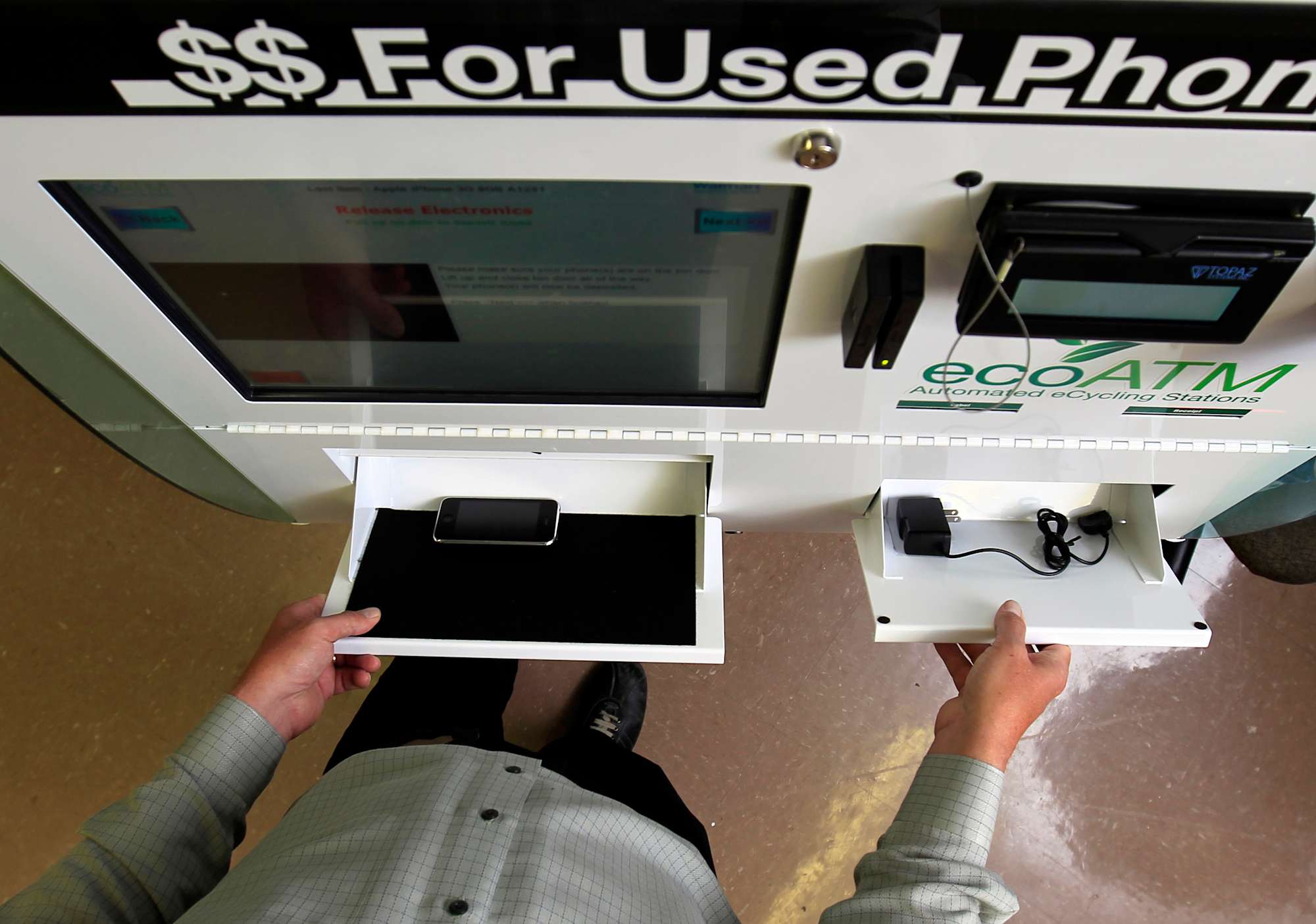
If you don't want to have to worry about packaging up your old device and mailing it off, or would like to receive your payout right away, there's always ecoATM. It's literally all in the name: the company operates automated machines that you place your device into to get it examined, and it pays you out on the spot. It accepts the biggest brands (i.e., Apple, Google and Samsung), along with devices from a wide variety of manufacturers, including LG, Motorola and ZTE. If the machine determines that your device isn't worth anything at all, you can still use ecoATM to responsibly recycle your old gadget. You'll find ecoATM kiosks in Walmart and Kroger locations, as well as malls and check-cashing stores across the country.
Amazon
While browsing Amazon listings, it’s likely you’ve come across products marked as “refurbished.” Well, if you’ve ever wondered where those come from, a lot of them likely hail from Amazon’s trade-in program. The company will put its own products, like Kindle ereaders and Fire tablets front and center, but you can also send in phones and gaming products in for an Amazon gift card as well. It’s not great if you want cash, but if you’re looking to upgrade an Amazon device, this option is your best bet, as trading in an older one also nets you a 20 percent discount in addition to the store credit. You’ll need to print out a shipping label, or you can drop off your electronics at select Amazon Locker, Whole Foods or uBreakiFix locations.
Apple
This is a good option if you’re looking to upgrade to a newer Apple device. You can trade in iPhones, iPads, Macs and even Apple Watches. That’s notable as wearables are a category you don’t often see on trade-in sites. Apple will even take your old Android phone if you were thinking of making the switch. The trade-in values are on par with other sites, but you can get a smaller payout in the form of a gift card instead if you’d rather wait before making a new purchase, want to put it toward media purchases or even just use it in an Apple Store. The latter, by the way, also accepts trade-ins in case you’re not comfortable shipping your old but still expensive device.
It'sWorthMore
The nice thing about It’sWorthMore is that its on-site forms handle a larger variety of gadgets than other sites, incorporating companies such as Microsoft, AMD and even GoPro in addition to standards like Apple, Samsung and Google. You’ll answer a few standard questions about your device’s condition and whether you still have the original box — obviously, the more you’ve kept from the original packaging, the better. You’ll then get a ballpark estimate of its worth and a prepaid shipping label to print out. Once your device has been received, you’ll generally get the assessment and payment via check, PayPal, Zelle or a gift card in under 10 days.
BuyBackWorld
The appeal of BuyBackWorld is that device assessment is a streamlined process: Instead of having to answer a barrage of detailed questions for your device you give it a general assessment and let the site handle the rest. Just like with It’sWorthMore, BuyBackWorld will provide a printable shipping label in your confirmation email but, if you don’t have a printer or boxes to pack your device up, you can always have the site send you a free shipping kit, which can handle everything the site takes except desktop computers.
GadgetGone
If you’ve read through the other site descriptions, GadgetGone’s modus operandi should be familiar: To sell a product, you’ll have to answer a few questions about what type of device you have and what condition it’s in, after which the site will generate a prepaid shipping label. At least here you can find brands like OnePlus included among the options, and you can also sell MacBooks and Mac minis here. You can get paid a number of ways, too, including PayPal, virtual VISA card, Amazon and Target gift cards or just good, old-fashioned bank transfer.
Store trade-ins
Sometimes you need your money right now, or just don't want to trust your device to the vagaries of various shipping companies. There are a few nationwide retailers that accept trade-ins for cash or store credit. Additionally, wireless carriers like Verizon, T-Mobile, and AT&T will all give you credit toward a new phone.
Best Buy
Best Buy also offers trade-ins both by mail and in-store — with more than 1,000 locations, this might be extremely convenient for you. You fill out the form online and bring that to customer service. It's easy, but there's one big downside: You can get your payout only via a Best Buy gift card. This is great if you spend a lot of money with them anyway, but not ideal if you need cash.
Target
Target isn’t as well known for its trade-in program, but it’s certainly a welcomed option. With over 1,900 locations across the US, it’s easy enough to bring your unwanted phones, tablets, game consoles, smart speakers and video games to a nearby Target’s electronics department for a quote. They’ll even package it up and ship it off to the processing facility for you. You’ll get a Target gift card via email within a week. If you can’t make it to a store, Target also offers a mail-in option.
GameStop
GameStop is infamous for buying games back at ridiculously low prices and flipping them at near retail, but don't let that stop you from making some easy cash when you need to quickly clear your closet of old electronics and games. And yes, I said cash: GameStop offers store credit, a Visa prepaid card or actual money if you want to take your bounty elsewhere. For example, you can trade in Super Mario Bros. Wonder for the Switch and get $35 in store credit or $24.50 cash, which isn't bad when new copies are going for $50 on Amazon. GameStop also accepts phones, tablets and Apple Watches, though the prices aren't going to match what you'd get from an online trade-in site.
Consumer to consumer
Sometimes you prefer to cut out the middleman and get a bit more personal — a transaction where you're selling your device directly to another person instead of letting a faceless site flip it for you as a "refurbished" unit. In those cases, you want a site that's more user-to-user, though a few will still automate certain bits to make your sale as smooth and secure as possible.
Swappa
Swappa is a marketplace site, which means sellers can set their own price. So if you're getting rid of a newer phone, this is probably the best way to go — the iPhone 14 fetches around $533, for example. That's a huge improvement over what you'd get selling through a site like Decluttr, which is offering only $267 for a 128GB unit.
Amazon
When shopping on Amazon, you've probably been tempted by some of those marketplace deals in the past and, chances are, if you list an item on there, someone will give your old device a look. Since almost everyone on earth seems to have an Amazon account, your potential customer base is huge, and it costs only $0.99, plus a percentage based on category, to sell an item through the site. The downsides are that Amazon isn't really optimized for individual sales; you'll be competing with wholesale companies and even bots that will tweak the price of a product automatically in response to the competition.
eBay
eBay is sort of the Wild West of sales sites, but the biggest advantage is that you can sell anything there and hopefully find a buyer, regardless of how old a product is. Even so, the site has come a long way in the past decade or so, adding structured categories that can help lead customers to your product. For phones, you can search by network, color or storage capacity, and even filter for features like 4K video or fingerprint sensors.
In the end, it still works as it always did: You list a product and set an end date for the listing with a minimum price, or just set a "Buy It Now" price if you don't want to wait to see how an auction turns out. Chances are you already have an eBay account with a feedback score, so there's no extra setup required on your part. Your first 250 listings are free every month, and you'll pay up to 15 percent of the purchase price only if an item sells. The biggest downside is that you're competing with a lot more sellers, and chances are there's always someone willing to undercut you on price.
Cash-back comparison
Ultimately, the site you go with should be whatever's most useful and convenient, but if you just care about how much money you'll get, we've priced out a few recent flagship handsets just to give you an idea of what each site will pay out.
All phone prices are for the lowest storage capacity, usually 128GB, and for devices that are in generally good condition with no cracks or scratches. The prices are for the unlocked models when available, or the carrier where it's being traded. These prices were valid the day this post was written, but they fluctuate daily or, in the case of sites like Amazon and eBay, hourly.
Apple iPhone 13 Pro Max
Samsung Galaxy S22 Ultra
Google Pixel 7
Declutter
$361
$268
$153
uSell
$455
N/A
N/A
ecoATM
$275
$185
$55
Verizon
$364
$223
$127
T-Mobile
$315
$210
$115
AT&T
$330
$230
$130
Best Buy
$340
$235
$115
GameStop
$498 credit / $349 cash
$181 credit / $127 cash
N/A
Swappa
$664
$539
$293
Amazon
$578
$460
$229
eBay
$350
$340
$214
BuyBackWorld
$375
$275
$150
It'sWorthMore
$446
$382
$165
GadgetGone
$476
$411
$218
If you were looking to sell some games, we've also got a shorter list, because not every site accepts trade-ins. GameStop will offer you more money than what's listed below if you're a member of its Elite or Elite Pro programs.
The Legend of Zelda: Tears of the Kingdom (Switch)
Final Fantasy XVI(PS5)
Diablo IV (Xbox)
Decluttr
$20
$16
$18
GameStop
$30 credit / $21 cash
$17 credit / $12 cash
$12 credit / $8 cash
Amazon
$10 trade-in / $45 marketplace
$34 marketplace
$34 marketplace
eBay
$12
$10
$15
Once you've picked a site and listed your item, there are a few important things to remember before you ship off your device. At the top of the list is to do a full factory reset before disposing of a phone or laptop (or any other device) containing personal data. That also means turning off "Find My iPhone" and the activation lock on iOS devices. See if you can unlock the phone, too; you'll actually get more money selling it carrier-free. And finally, make sure you've backed up any important data you may have, like contact info, game saves and, of course, photos. Cash is great, but it won't save your memories.
Images: Mike Blake / Reuters (ecoATM); Alamy (Gamestop); Getty Images for eBay (eBay)
This article originally appeared on Engadget at https://ift.tt/maGx136
from Engadget is a web magazine with obsessive daily coverage of everything new in gadgets and consumer electronics https://ift.tt/maGx136